


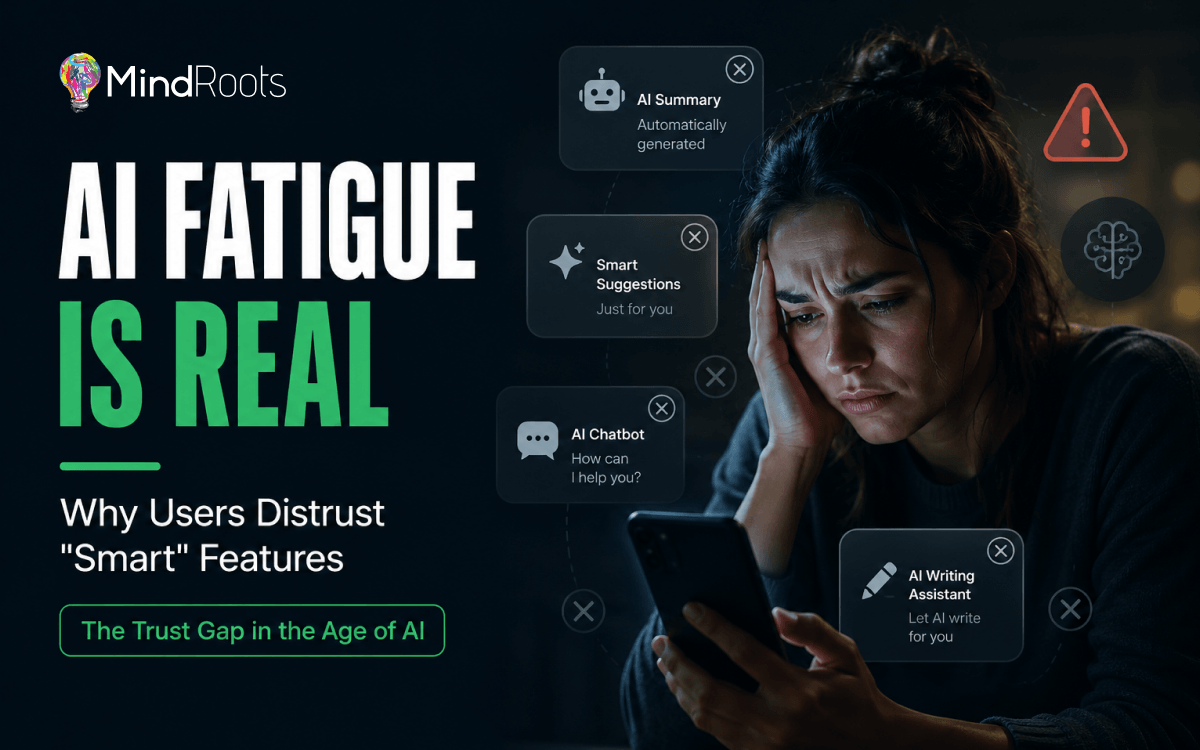
Open any app store review section right now and you will find a familiar complaint pattern. Someone downloaded an app to do one specific thing, and now a chatbot greets them on launch, an AI summary sits atop content they wanted to read in full, and a settings menu buried three levels deep is the only way to turn any of it off. Words like “annoying,” “unnecessary,” and “just let me use the app” show up constantly on Reddit threads, X posts, and one star reviews across categories from email clients to note taking tools.
This is AI fatigue, and it is not a fringe reaction. It is a measurable shift in public sentiment. A 2025 Pew Research Centre survey found that half of American adults say the growing presence of AI in daily life makes them more concerned than excited, up sharply from 37 percent when Pew first asked the question in 2021. The same research found that a majority of Americans want more control over how AI is used in their lives, and most feel they have little or no say in when and how it shows up. Edelman’s 2025 Trust Barometer flash poll on AI told a similar story, with trust in AI sitting at just 32 percent among people in the United States, far below levels seen in China and Brazil.
For product teams, marketers, and founders, this is not an abstract cultural trend. It is a direct threat to adoption, retention, and brand credibility. Understanding why AI fatigue is happening, and how to design around it, is quickly becoming a core competency.
What AI Overreach Looks Like
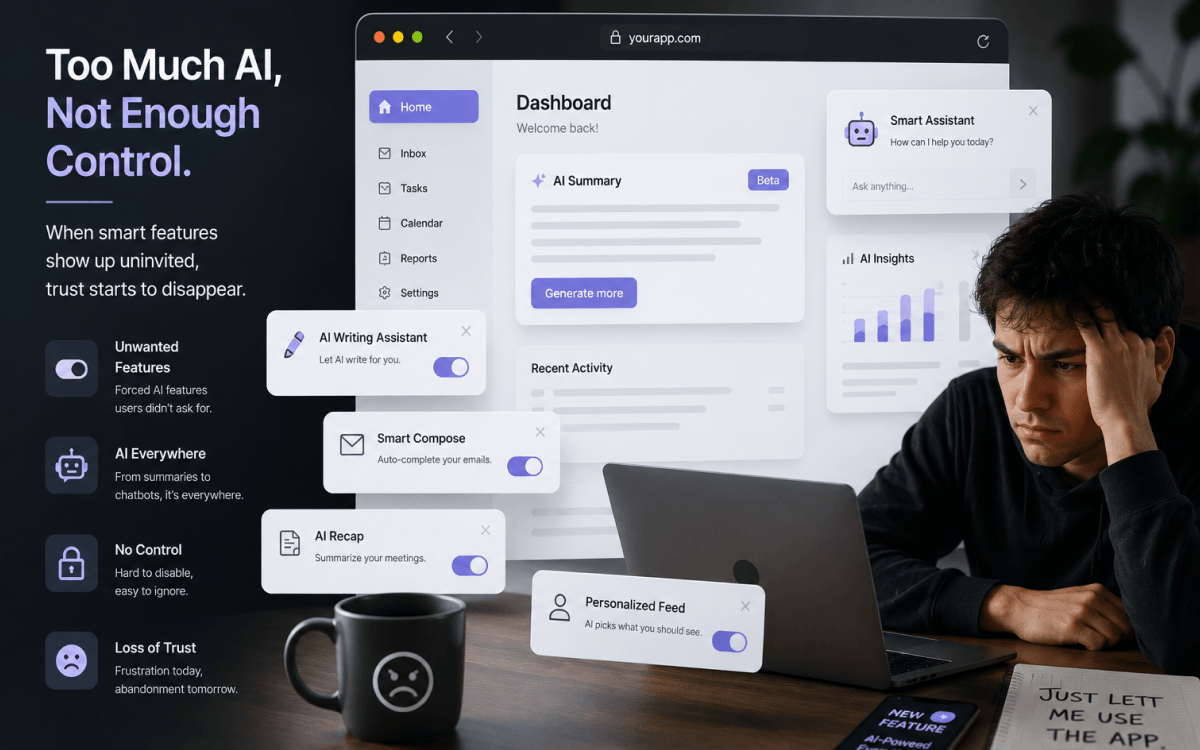
AI fatigue rarely comes from one dramatic failure. It builds through small, repeated friction points that erode user agency over time. Common offenders include:
- Unsolicited AI summaries. Email clients and search engines increasingly insert generated summaries above content a user asked to read in full, adding an extra step and a layer of uncertainty about accuracy.
- Autocomplete that rewrites intent. Predictive text and AI assisted writing tools that finish sentences in ways the user did not mean, forcing constant correction rather than saving time.
- AI generated recaps nobody requested. Meeting summaries and “your week in review” digests that appear by default and clutter interfaces that were previously clean.
- Chatbots that gatekeep human support. Support flows that route every request through a bot first, with human contact hidden behind repeated failed attempts, a dark pattern that frustrates users at the exact moment they are already stressed.
- Persistent popups promoting “smart” features. Repeated prompts nudging users toward AI tools they already dismissed, which reads less like helpfulness and more like feature bloat driven by roadmap pressure.
None of these examples are inherently bad ideas. The problem is implementation: features shipped by default, without clear opt in consent, and without an easy way to turn off.
Why AI Fatigue Is Happening Now
Market Saturation and AI Washing
Nearly every software category has rushed to attach an “AI powered” or “smart” label to existing functionality, whether or not the underlying capability changed meaningfully. This practice, often called AI washing, has trained users to be sceptical of the label itself. When every product claims AI enhancement, the term stops signalling value and starts signalling marketing spin. Industry analysts, including Gartner, have flagged this pattern as a growing risk, noting that many self-described AI products deliver limited measurable benefit to users.
Lack of Transparency
Most AI features operate as a black box. Users are not told what data feeds the model, how confident the output is, or why a particular summary or suggestion was generated. This absence of algorithmic transparency breeds suspicion, especially when outputs are wrong. People are far more forgiving of a mistake they understand than one that appears to come from nowhere.
Loss of Control and Agency
Pew’s research points directly at this issue: most Americans feel they have little control over how AI touches their daily lives. When a feature activates by default or intercepts a task without permission, it signals that the product prioritizes company objectives over user preference, one of the fastest ways to turn a curious user into a frustrated one.
Privacy Concerns
Smart features frequently require processing personal content, whether that is an inbox, a document, or a conversation history. Users increasingly question where that data goes, how long it is retained, and whether it trains future models. Without clear answers, even a useful feature can feel invasive.
Inconsistent Output Quality
Generative AI output quality varies. A summary might be accurate nine times and subtly wrong the tenth, and that tenth failure is often what a user remembers. Inconsistent reliability undermines confidence more than a feature that is consistently mediocre but predictable.
The Business Risk of Ignoring AI Fatigue
The cost of dismissing AI fatigue as noise is significant, and it shows up in several measurable ways.
Trust erosion compounds quickly. Once a user associates a brand with intrusive, low value AI additions, that skepticism tends to color their perception of the entire product, not just the feature in question. Negative app store reviews and social posts about unwanted AI behaviour are highly visible and get amplified because so many people relate to the frustration.
Feature abandonment is another quiet cost. Internal usage data at many companies shows AI features with high initial exposure but low sustained engagement, technically live but functionally ignored, wasting development resources while still consuming interface space and cognitive load.
Churn is the most severe consequence. When users feel a product no longer respects their attention, switching starts to feel worthwhile, and a product perceived as bloated with unwanted AI dressing can lose ground to a leaner competitor that markets restraint as a feature.
How Companies Can Rebuild AI Trust
Recovering user confidence does not require abandoning AI investment. It requires a shift in how features are introduced and governed.
Default to Opt In, Not Opt Out
Ship new AI capabilities off by default and let users choose to activate them. This respects user agency and turns adoption data into a genuine signal of value rather than a byproduct of default settings.
Disclose How Features Work
Clear, plain language explanations of what an AI feature does, what data it uses, and its known limitations go a long way toward building algorithmic transparency. Users do not need a technical breakdown of model architecture, but they do want the basics.
Make Controls Easy to Find
Every AI feature should have an obvious, one click way to disable it. Burying settings or requiring multiple steps to opt out functions as a dark pattern, even if that was not the intent.
Prioritize Human in the Loop Design
For customer support, financial decisions, or sensitive communication, keep a visible path to a human. Human in the loop design signals that AI is a tool assisting the experience, not a barrier standing in front of it.
Focus on Utility Over Novelty
Before shipping a smart feature, product teams should ask whether it solves a real problem or exists primarily to justify an AI roadmap line item. Features built around genuine utility survive user scrutiny. Features built around novelty tend to become the next round of complaints.
The Bottom Line
AI fatigue is not a rejection of artificial intelligence itself. It is a reaction to how carelessly many of these features have been deployed, without consent, without explanation, and without an exit. The companies that earn lasting trust will not necessarily be the ones shipping the most AI capability, but the ones treating every added layer of intelligence as something that must earn its place in a user’s workflow. Restraint, clarity, and respect for user choice are becoming the real competitive advantage in a market grown tired of being told what is smart for it.
Frequently asked questions
AI fatigue refers to the growing weariness and scepticism users feel toward the constant presence of AI powered features in the products they use. It stems from repeated exposure to unwanted, poorly explained, or low value smart additions that interrupt workflows rather than improve them.
2. Why do users distrust AI features in apps and software?Distrust typically comes from a lack of transparency about how AI features work, a feeling of lost control when features activate without consent, inconsistent output quality, and privacy concerns about how personal data is used. Survey data from organizations like Pew Research and Edelman confirms this scepticism is widespread rather than isolated.
3. What is AI washing?AI washing is the practice of labelling a product or feature as “AI powered” or “smart” without delivering meaningful new capability or value. It is a marketing tactic that has become common enough to make users sceptical of AI claims in general.
4. How can companies reduce AI fatigue among their users?Companies can reduce AI fatigue by making AI features opt in rather than opt out, clearly disclosing how the features work, providing easy controls to disable them, and prioritizing genuine utility over novelty. Maintaining accessible human support options also helps preserve trust.
5. Does AI fatigue mean users are against AI entirely?Not necessarily. Research shows many users are open to AI in specific, well defined contexts like data analysis or task automation, but they resist AI that is imposed on them without choice or explanation. The core issue is control and transparency, not opposition to the technology itself.