


The way businesses build their technology teams has changed for good. What began as a temporary shift a few years ago has settled into a permanent, deliberate strategy. Companies of every size, from two person startups to global enterprises, are choosing remote teams not because they have to, but because it makes sound business sense. Hiring remote developers, building a distributed workforce, and partnering with an offshore development team are no longer backup plans. They are the primary way modern companies scale, innovate, and protect themselves against risk.
This post explores why remote software development has become the smarter growth path for organizations at every stage, what concerns still hold some businesses back, and how a partner like Mind Roots helps companies hire remote resources with confidence.
The Shift From Office First to Remote First Growth
For decades, growth meant renting more office space, relocating talent, and building teams within driving distance of headquarters. That model is fading fast. Today, growth means finding the right skill set wherever it exists in the world and bringing it into the business through remote hiring.
This shift is not just about convenience. It reflects a deeper realization: physical location has almost nothing to do with the quality of software, the speed of delivery, or the strength of an idea. A brilliant mobile app developer in one country can build just as effectively as one sitting three floors above the CEO. Once businesses accepted this, remote teams stopped being an experiment and became a core growth engine.
Startups embraced this shift first, largely out of necessity. Enterprises followed once they saw the results. Together, they have reshaped how software gets built, redefining what it means to hire remote developers and manage distributed teams at scale.
Why Startups Are Choosing Remote Teams From Day One
Startups live and die by speed, capital efficiency, and access to talent. Remote teams solve all three problems at once.
Early stage founders rarely have the budget to build a large in house engineering department. Instead, many are turning to software outsourcing and IT staff augmentation to assemble a dedicated development team without the overhead of full time local hires. This allows a startup to launch an MVP, test a market, and iterate quickly, all while keeping burn rate under control.
Remote hiring also opens the door to specialized skills that may not exist locally. A startup building an AI powered product can bring on AI solutions development experts from anywhere in the world. A company launching a consumer app can hire remote developers who specialize specifically in mobile app development, rather than settling for generalists nearby. This access to niche expertise is often the difference between a product that struggles and one that scales.
Why Enterprises Are Following the Same Model
It is tempting to assume remote teams are only useful for small, resource constrained companies. Enterprises have proven otherwise. Large organizations with established budgets and in house talent are increasingly turning to remote software development for the same reasons startups do: speed, cost control, and access to skill.
Enterprise software development projects are often large, complex, and time sensitive. Building every capability internally can slow delivery and inflate costs. By partnering with an offshore development team, enterprises can spin up additional capacity quickly, tackle end to end software development projects without overloading internal staff, and bring specialized expertise into web application development, custom software solutions, and modernization initiatives.
Remote teams also give enterprises flexibility that internal hiring cannot match. A business can scale a project team up during a major product launch and scale back down once the work stabilizes, all without the long term commitment of permanent headcount. This agility has become a competitive advantage in industries where speed to market defines success.
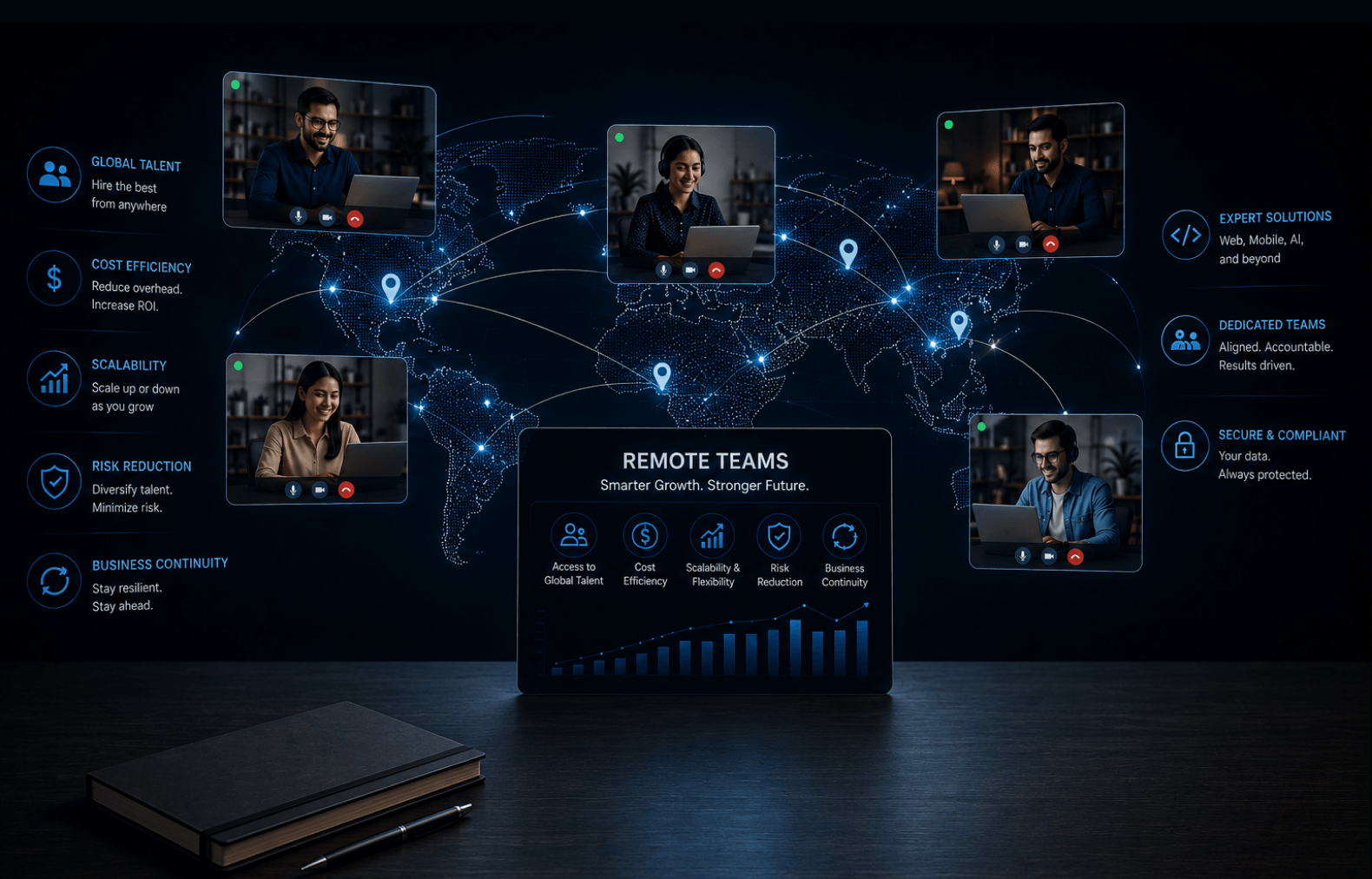
Cost, Safety, and Scalability Benefits Explained
Cost Efficiency
Remote hiring removes many of the expenses tied to traditional employment: office space, local benefits packages, equipment, and relocation costs. Businesses that hire remote resources from regions with strong technical talent and favorable cost structures can access highly skilled developers at a fraction of the cost of hiring locally, without compromising quality.
Risk Reduction
Relying entirely on a single local talent pool creates risk. Local hiring markets can tighten, salaries can spike, and competition for skilled developers can leave positions unfilled for months. Remote teams diversify this risk. A company is no longer dependent on one city or one country’s job market to keep projects moving.
Access to Global Talent
Remote developer hiring gives businesses access to a far larger and more diverse talent pool. Instead of competing for a limited number of local engineers, companies can hire remote developers with the exact skill set a project requires, whether that is a specialist in web application development, a mobile engineer, or a team experienced in AI solutions development.
Scalability
Perhaps the biggest advantage is scalability. A dedicated development team can expand or contract based on project needs. This is far more efficient than the slow, expensive cycle of hiring and layoffs that comes with traditional staffing models. Businesses can scale remote software development capacity up during growth phases and adjust down when needed, keeping operations lean and responsive.
Business Continuity
Distributed teams also strengthen business continuity. When talent, infrastructure, and operations are spread across locations, a single local disruption, whether a natural event, a regional shutdown, or an economic downturn, has far less impact on the overall business. Remote teams are inherently more resilient.
Addressing Security and Management Concerns
Despite the clear benefits, some businesses still hesitate before building remote teams. These concerns are valid, but they are also well understood and well solved today.
Security is often the first worry. Modern remote software development relies on secure cloud infrastructure, encrypted communication channels, controlled access permissions, and strict data handling protocols. Reputable outsourcing and staff augmentation partners follow established security frameworks so that sensitive business data remains protected regardless of where a developer is physically located.
Communication is another common concern, especially across time zones. In practice, most distributed teams solve this with structured overlap hours, asynchronous updates, and modern collaboration tools that keep everyone aligned. Daily standups, shared project boards, and clear documentation reduce the friction that used to make remote coordination difficult.
Quality control is maintained through defined development processes, code reviews, testing pipelines, and clear milestones. A well managed dedicated development team follows the same quality standards as an in house team, often supported by project managers who bridge communication between the client and the remote resources.
Time zone differences, once seen as a drawback, are now often treated as an advantage. Many businesses use time zone spread intentionally, allowing development work to continue around the clock as tasks move from one region’s working hours into another’s.
How Mind Roots Can Help You With Your Remote Resources Requirement
Mind Roots specializes in helping startups and enterprises build strong, reliable remote teams without the guesswork. Whether a business needs to hire remote developers for a short term project or build a long term dedicated development team, Mind Roots provides a structured, transparent path to doing it right.
Through IT staff augmentation, businesses can add skilled remote developers to existing teams to fill gaps quickly, without the delays of traditional hiring. For companies that need a full offshore development team, Mind Roots offers software outsourcing solutions covering end to end software development, from initial planning through deployment and support.
Mind Roots supports a wide range of technical needs, including web application development, mobile app development, AI solutions development, and custom software solutions built around specific business goals. For larger organizations, Mind Roots also brings experience in enterprise software development, helping enterprises scale complex projects with remote resources that meet strict quality and security standards.
Every engagement is built on clear communication, defined processes, and accountability, so businesses can hire remote resources with confidence that projects will be delivered on time, securely, and to a high standard.
Conclusion: Build Your Remote Team Today
Remote teams are no longer a temporary workaround. They are a proven, strategic approach to growth that benefits startups and enterprises alike. From cost efficiency and risk reduction to scalability and access to global talent, the advantages of remote software development are too significant to ignore.
If your business is ready to hire remote developers, build a dedicated development team, or partner with an offshore development team that understands both startup agility and enterprise scale, now is the time to act. Reach out to Mind Roots today and take the next step toward building a smarter, safer, and more scalable remote team.