


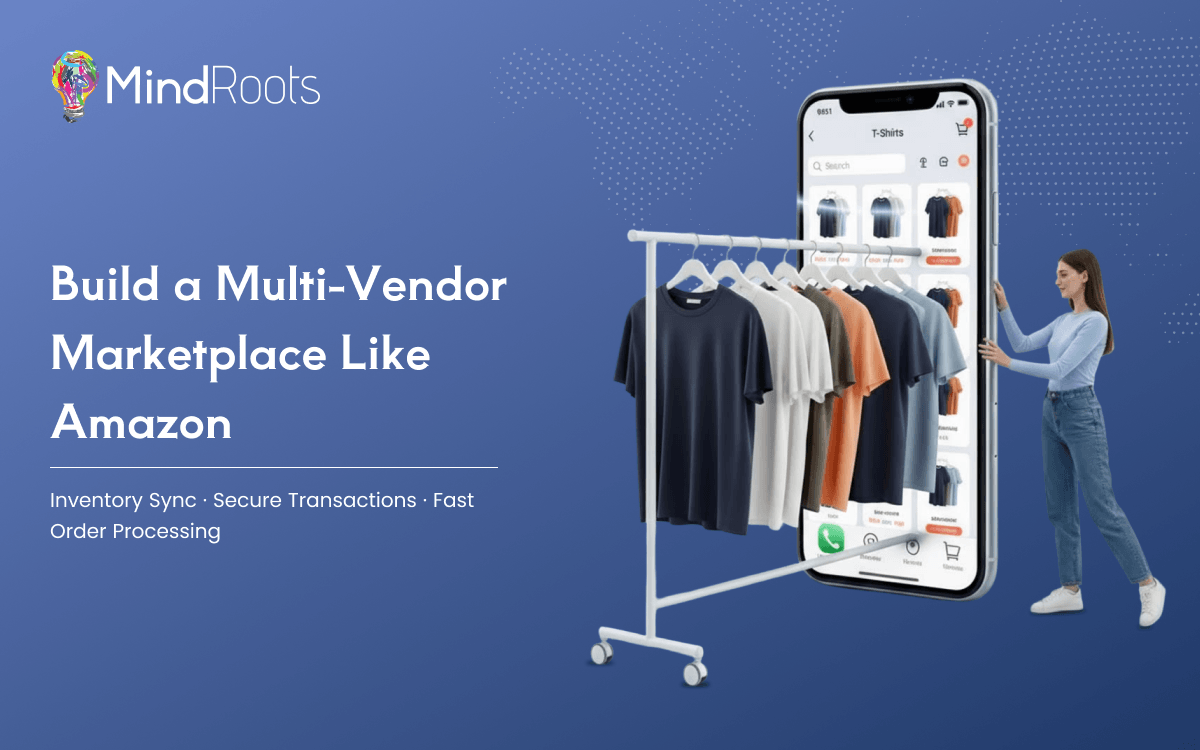
Almost every founder who calls us with a marketplace idea eventually says some version of “we want to be the Amazon of X.” It’s an understandable ambition, and it’s also the wrong one. Amazon didn’t win because it sells everything. It won because it built infrastructure, vendor tooling, logistics, and trust mechanisms that let thousands of independent sellers operate as if they were one seamless storefront. That is the part worth copying.
The more useful question isn’t “how do we become that big,” it’s “how do we apply the same architectural discipline to a category small enough to dominate.” If you can build a multi-vendor marketplace like Amazon in terms of engineering rigor, not scale, you can compete in a niche Amazon has no incentive to serve well. This guide breaks down exactly how that architecture works, what it costs in 2026, and where founders typically get it wrong.
The Market Context: Marketplaces Are Where Ecommerce Growth Is Concentrated

Core Architecture: What Actually Makes a Marketplace Work
A multi-vendor marketplace is not an ecommerce store with more sellers bolted on. It’s a distinct category of software with its own architectural demands, and the decisions you make early determine whether the platform can scale past a few hundred vendors or collapses under its own complexity.
Microservices vs monolith.
A monolith, where the entire application runs as one codebase, is fine for an early MVP because it’s faster and cheaper to build. But marketplaces have independently scaling components (search traffic behaves nothing like checkout traffic), so most platforms migrate toward microservices, an architecture where each function (catalog, orders, payments, notifications) runs as its own deployable service. This lets you scale the parts under load without over provisioning the rest.
Vendor onboarding and catalog service.
This is the backbone of a multi-vendor platform. It needs self service seller registration, document verification, product upload (often bulk, via CSV or API), category mapping, and approval workflows, all without engineering intervention per vendor.
Order orchestration.
A single customer order might split across five vendors, each with different fulfillment timelines. Order orchestration is the logic layer that tracks each sub-order independently while presenting one coherent order to the buyer.
Inventory sync.
Real time or near real time stock updates across vendor systems, so a product doesn’t sell after it’s already gone.
Search and discovery.
Typically powered by Elasticsearch or Apache Solr, indexes millions of listings for fast, relevant, faceted search, which is what buyers actually judge a marketplace on within the first ten seconds.
Payment splitting.
This usually means escrow style marketplace payments (Stripe Connect, Adyen for Platforms) that hold funds until fulfillment conditions are met, then automatically split payouts between the platform and each vendor according to commission rules.
API gateway design.
A single entry point that routes requests to the right microservice, handles authentication, and enforces rate limits, so the complexity underneath stays invisible to every client app.
Getting this foundation right is where most marketplace projects succeed or stall, and it’s the core of what our team focuses on before a single UI screen is designed.
Recommended Tech Stack for 2026
- Frontend: React or Next.js for web, React Native or Flutter for cross platform mobile, with a headless commerce approach so the storefront can be redesigned without touching backend logic
- Backend: Node.js or Java (Spring Boot) for high concurrency services, with event driven architecture (Kafka or RabbitMQ) so services communicate through events rather than direct, brittle calls
- Database: PostgreSQL for transactional data, MongoDB for flexible catalog data, Redis for caching and session management
- Cloud infrastructure: AWS or GCP, with containerization (Docker, Kubernetes) enabling horizontal scaling, the ability to add more servers under load rather than upgrading one bigger machine, plus a CDN for fast global asset delivery
- AI layer: Recommendation engines using vector search (embeddings that match buyer intent to relevant listings), fraud detection models scoring transactions in real time, and dynamic pricing or demand forecasting tools; this is where our AI Solutions Development practice typically plugs in
- DevOps and CI/CD: GitHub Actions or GitLab CI, infrastructure as code (Terraform), and automated testing pipelines so releases ship without manual regression checks
This stack is built for multi-tenant SaaS from day one, meaning multiple vendors and buyer segments run securely on shared infrastructure, which matters if you ever plan to license the platform itself, a direction several of our SaaS Product Development clients have taken after their marketplace proved the model.
Monetization Models for a Multi-Vendor Marketplace
The architecture only matters if it supports a revenue model that actually works at your transaction volume, and this is where founders often default to “Amazon’s model” without asking whether it fits their category.
- Commission on transactions. The most common model, typically 5% to 20% depending on category margin, taken automatically at the payment splitting stage described above. This scales naturally with GMV but means revenue is zero until vendors start selling.
- Vendor subscription or listing fees. A recurring fee for sellers to access the platform, sometimes tiered by catalog size or feature access. This creates predictable revenue independent of transaction volume, which is useful for marketplaces with high average order value but lower frequency.
- Featured placement and advertising. Vendors pay for improved search ranking or homepage visibility, a model that depends on having enough buyer traffic and search volume to be worth paying for, so it’s rarely viable at launch.
- Fulfillment and value added services. Charging vendors for warehousing, shipping label generation, or customer support handling, which works well once order volume justifies building that infrastructure in house.
- Hybrid models. Most mature marketplaces blend two or three of the above, commission as the base, subscription for power sellers, and advertising once traffic supports it, rather than committing to a single lever from day one.
The right mix depends less on what Amazon does and more on your category’s margin structure and how price sensitive your vendors are, which is a conversation worth having before the payment architecture is finalized rather than after.
Scalability and Security Considerations
A marketplace that works for 50 vendors needs different infrastructure than one supporting 5,000. Load balancing distributes incoming traffic across servers so no single instance becomes a bottleneck during peak shopping periods. Multi tenant architecture must isolate vendor data logically even while sharing infrastructure, which becomes a compliance requirement, not just a performance one, once you’re handling payment data. PCI DSS compliance is mandatory for any platform processing card transactions, and it shapes how you architect payment flows from the start rather than something to retrofit later. Cloud native design, the kind our Cloud Solutions team builds around, gives you the elastic capacity to absorb demand spikes (a viral product, a seasonal surge) without downtime, which for a marketplace is often the difference between a good launch and a reputation you don’t recover from.
Why Partner With an Experienced Development Team
Marketplace platforms fail more often from architectural decisions made in month one than from anything that happens after launch. Choosing a monolith too early, underestimating payment splitting complexity, or skipping proper vendor onboarding tooling are mistakes that are expensive to unwind once real vendors and real revenue depend on the system. An experienced partner brings pattern recognition from platforms that have already hit these walls, along with the ability to sequence your roadmap so you’re not paying to rebuild core infrastructure eighteen months in. That’s less about writing code faster and more about not building the wrong thing well.
Ready to Build Your Marketplace?
Frequently asked questions
A functional MVP typically runs $15,000 to $20,000, while a scalable, production grade platform with AI features and microservices architecture ranges from USD 70,000- USD 80,000. Costs depend heavily on vendor complexity, integrations, and region of the development team.
2. What’s the difference between a multi-vendor and single-vendor marketplace platform?A single-vendor platform sells one brand’s products through one storefront, similar to a standard ecommerce site. A multi-vendor marketplace hosts many independent sellers, each with their own catalog, inventory, and payout, requiring onboarding workflows, commission logic, and order splitting that single-vendor platforms don’t need.
3. How long does it take to build an MVP multi-vendor marketplace?Most MVPs take four to six months from discovery to launch, assuming a focused feature set: vendor onboarding, product catalog, checkout, and basic search. Adding AI recommendations, advanced logistics, or multiple payment regions extends that timeline.
4. What tech stack is best for a scalable marketplace platform?There’s no single “best” stack, but a common, proven combination in 2026 is React or Next.js on the frontend, Node.js or Java microservices on the backend, PostgreSQL and MongoDB for data, and AWS or GCP for cloud infrastructure with Kubernetes for scaling.
5. How do you handle vendor payments and commissions on a marketplace?Most platforms use escrow style marketplace payment providers like Stripe Connect or Adyen for Platforms, which hold buyer funds until order conditions are met, then automatically split and release payouts to vendors based on your commission rules.
6. Do I need AI features in my marketplace from day one?No. Most successful marketplaces launch with core buyer and seller flows first, then layer in AI recommendations, fraud detection, and dynamic pricing once there’s enough transaction data for those models to be useful. Building AI in too early often means optimizing against data that doesn’t exist yet.