



Manufacturing companies often run on decades of engineering excellence, yet their websites tell a different story. Many still rely on outdated content management systems, slow loading pages, and layouts that were never built with mobile users in mind. These issues quietly undermine credibility with buyers who now research suppliers online long before ever picking up the phone.
This case study walks through a real project with a midsize industrial equipment manufacturer that produces custom machinery components for automotive and aerospace clients. The company had a strong reputation built over thirty years, but its digital presence had not kept pace. Engineers and procurement teams visiting the site regularly abandoned it out of frustration, and the sales team knew something needed to change. What follows is how our team approached the problem, the modernization process we implemented, and the measurable results that came from it.
The Challenge
The client’s existing website was built on a legacy content management system that had not been updated in nearly eight years. Every content change required a developer, which meant the marketing team could rarely publish new product information or case studies without weeks of delay. This alone put the company at a disadvantage against competitors who could update their sites in hours.
Beyond the outdated CMS, the site suffered from a long list of technical and experience problems that are common in industrial website development projects:
- Average page load times exceeding six seconds on desktop and nearly eleven seconds on mobile
- A non responsive design that rendered product specification tables unreadable on phones and tablets
- Weak search engine visibility, with most product pages ranking beyond page three for relevant industry terms
- An interface that looked visually dated compared to competitor sites
- A conversion rate under one percent on request for quote forms
- A product catalog with hundreds of technical SKUs organized in a confusing, multi layer menu structure that buried key specifications
Procurement professionals and engineers, who make up the bulk of this company’s audience, expect fast access to detailed technical data. When that data is hard to find, they simply move on to a competitor’s site. This was quietly costing the client qualified leads every month.
Our Approach and Discovery Process
Before writing a single line of code, our team ran a full user experience audit alongside a technical SEO audit to understand exactly where the site was failing. This dual audit approach is essential for any manufacturing website performance optimization project because technical issues and experience issues are often deeply connected.
The discovery phase included several parallel workstreams. We analyzed Core Web Vitals data using Google’s official measurement tools to identify specific bottlenecks in loading performance, interactivity, and visual stability. We also conducted a competitor benchmarking exercise, reviewing five direct competitors to see how their sites handled product navigation, mobile responsiveness, and page speed.
Stakeholder interviews rounded out the discovery process. We spoke with the sales team, customer service representatives, and several existing customers to understand what information buyers actually needed during their research phase. These conversations revealed that customers wanted quick access to CAD files, material specifications, and certifications, none of which were easy to find on the old site.
The Modernization Process
UI and UX Redesign
Our design team began with a complete overhaul of the information architecture, mapping out a simplified navigation structure organized around how buyers actually search for industrial products rather than how the company was internally organized. We built low fidelity wireframes first, testing them with actual customers before moving into high fidelity design. The result was a responsive design for manufacturers that adapts cleanly across desktop, tablet, and mobile screens without losing any of the technical detail that engineers rely on.
Performance Optimization
Website speed optimization became a central focus once the design phase was underway. Our development team compressed and converted all product images to modern formats, implemented lazy loading so pages only load images as users scroll to them, and configured browser caching to reduce repeat load times for returning visitors. We also deployed a content delivery network to serve assets from servers closer to the client’s geographic customer base and minified all CSS and JavaScript files to reduce overall page weight.
Technology Stack Upgrade
The outdated CMS was replaced with a headless CMS, giving the marketing team the ability to update product pages, technical documents, and blog content without developer involvement. We paired this with a modern frontend framework that rendered pages faster and more reliably than the previous system. API integrations connected the new site directly to the company’s inventory and specification database, so product data stays accurate without manual updates.
SEO Enhancements
Technical SEO for manufacturing companies requires more than keyword placement. We implemented structured schema markup across product pages so search engines could better understand technical specifications, pricing availability, and company information. Metadata across every page was rewritten to reflect actual search intent, and we restructured the site’s internal linking and sitemap so search engines could crawl and index the full product catalog efficiently.
Accessibility Improvements
We also brought the site into alignment with WCAG guidelines and ADA standards, adding proper alt text, keyboard navigation support, color contrast corrections, and screen reader compatibility across every template. This was not just a compliance exercise. Many procurement teams at larger enterprises now require accessibility compliance from their suppliers as part of vendor qualification.
Results and Outcomes
Within four months of launch, the redesigned site delivered measurable improvements across every key metric the client cared about:
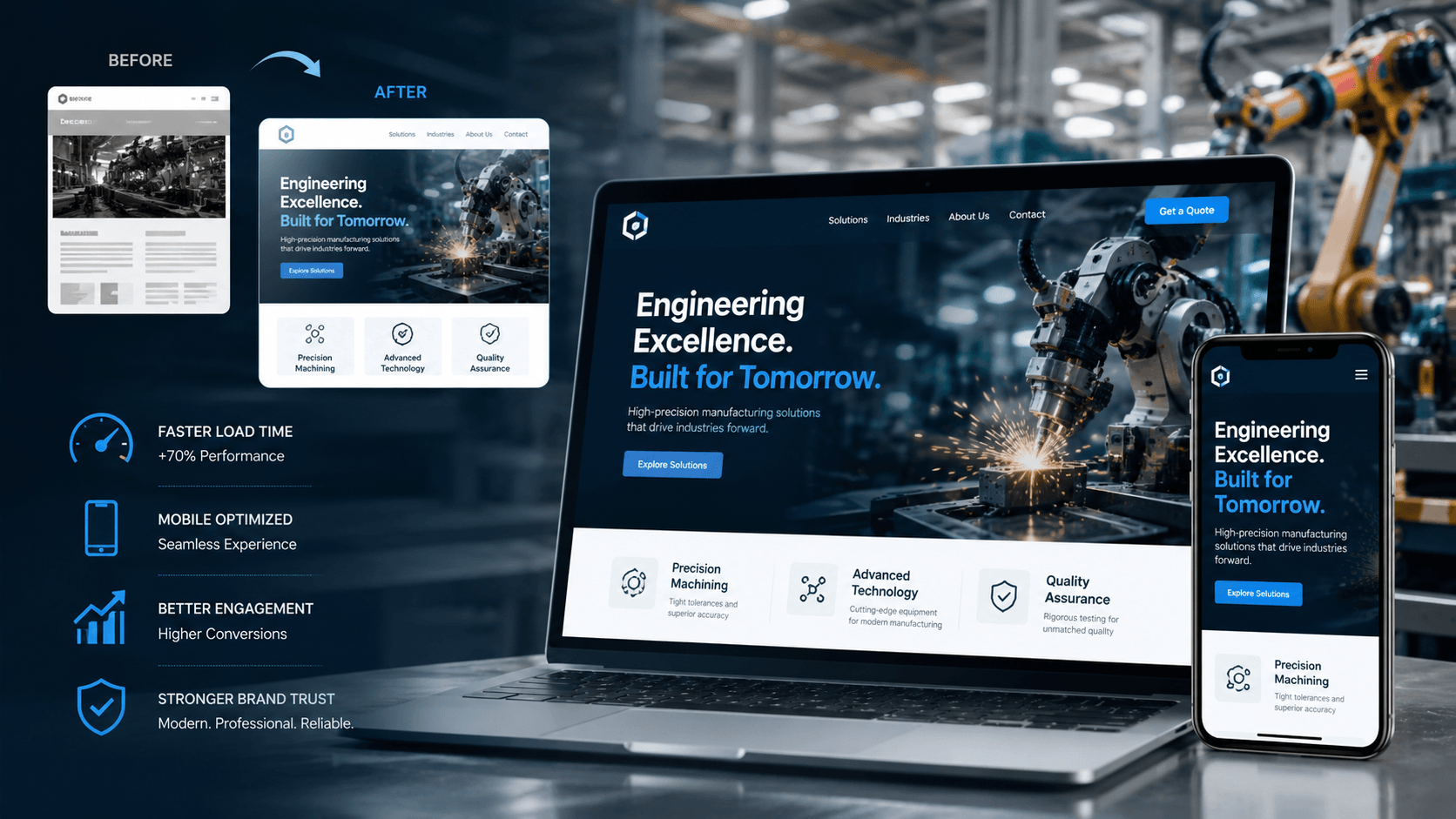
- Average page load speed dropped from six seconds to under two seconds on desktop and under three seconds on mobile
- Bounce rate decreased by thirty eight percent across product pages
- Organic search traffic increased by sixty one percent within the first six months
- Request for quote conversion rate improved from under one percent to just over three percent
- Mobile usability scores in Google Search Console rose from sixty two to ninety six out of one hundred
- Qualified lead volume from the website increased by forty four percent year over year
These results reflect a pattern we see consistently in B2B website UX projects within the manufacturing sector. When buyers can find technical information quickly and trust the site’s credibility, they engage further down the sales funnel.
Key Takeaways for Manufacturing Businesses
This project reinforced several lessons that apply broadly to manufacturing companies considering a digital overhaul:
- Speed and mobile experience are not optional extras. A large share of technical buyers now research suppliers from mobile devices during site visits or between meetings.
- Product catalog navigation should be organized around buyer intent, not internal company structure.
- A flexible content management approach allows marketing teams to keep technical content current without bottlenecking every change through a developer.
- Search engine visibility and user experience improvements reinforce each other rather than competing for resources.
- Accessibility compliance is increasingly a business requirement, not just a legal consideration, particularly when selling to enterprise procurement teams.
Frequently asked questions
Costs vary significantly based on catalog size, integration complexity, and whether a full technology stack upgrade is included. Projects involving a large technical product catalog and custom API integrations generally require a larger investment than a standard marketing site redesign.
2. How long does a website modernization project take?Most manufacturing website redesign for manufacturers projects take between three and six months from discovery through launch, depending on catalog size and how many legacy systems need to be integrated or replaced.
3. Will a redesign actually improve our search engine rankings?Yes, when the project includes proper technical SEO work alongside the visual redesign. Improvements to Core Web Vitals, site structure, and metadata directly influence how search engines evaluate and rank a site.
4. Should we redesign our existing site or rebuild it from scratch?This depends on the condition of the current technology stack. If the CMS is severely outdated or cannot support modern performance standards, a rebuild on a headless CMS often makes more sense than attempting incremental redesign.
5. Can B2B manufacturing sites support ecommerce functionality?Absolutely. Many manufacturers are adding self service ordering, quote request automation, and account based pricing portals alongside their standard product catalog, particularly for repeat customers ordering standard parts.
6. Do we need a mobile app, or is a responsive website enough?For most manufacturing companies, a well built responsive website meets buyer expectations without the added cost and maintenance burden of a native mobile app.
7. Ready to Modernize Your Manufacturing Website?Outdated websites cost manufacturing companies real business, often in ways that are difficult to see without a proper audit. If your site is slow, hard to navigate, or simply not generating the leads it should, we would welcome the opportunity to take a closer look. Reach out to our team for a comprehensive website audit and consultation, and let us show you what a modernized digital presence could do for your business.