


As service businesses grow, managing customer relationships becomes increasingly complex. What begins as a simple process involving spreadsheets, emails, and phone calls can quickly become a challenge that impacts sales performance, customer satisfaction, and operational efficiency.
Whether it is a home services company in the United States, a consulting firm in the United Kingdom, a facility management provider in Dubai, an IT services company in Australia, or a rapidly growing startup in India, the need for a streamlined and scalable customer management system becomes critical as operations expand.
One of our clients faced exactly this challenge. Their business had experienced significant growth over the years, but their internal systems had not evolved at the same pace. Customer information was scattered across multiple tools, follow-ups were tracked manually, and management lacked clear visibility into overall business performance.
Although the client evaluated several popular CRM platforms, none of them fully aligned with the way their teams operated. The available solutions either lacked essential workflow flexibility or required the business to significantly change its existing processes.
At Mind Roots, we partnered with the client to design and develop a custom CRM platform tailored specifically to the needs of service-based businesses. Rather than forcing the organization to adapt to generic software, we built a solution around their operational workflows, customer journey, and long-term business objectives.
In this article, we share our development journey, the technical decisions behind the platform, the challenges we overcame during implementation, and the business outcomes achieved after deploying the solution.
Understanding the Business Challenges
Before beginning development, our team invested significant time in understanding how the organization operated. One of the most important lessons we have learned through years of software development is that successful CRM platforms are built around business processes rather than feature lists.
Through workshops and stakeholder interviews, we discovered that customer enquiries were arriving through multiple channels, including the company website, email campaigns, social media platforms, referrals, and direct phone calls. Because each department maintained separate records, employees often struggled to access complete customer information.
Sales representatives frequently spent time searching for historical communication records. Customer service teams lacked visibility into previous interactions. Managers relied on manually prepared reports that were often outdated by the time they reached decision-makers.
The result was a fragmented customer experience, reduced productivity, and missed revenue opportunities.
These findings helped establish the foundation for the CRM and ensured that every feature addressed a genuine business need.

Creating a CRM Architecture Designed for Growth
Once the business requirements were clearly defined, the next step was to design a technology architecture capable of supporting both current operations and future expansion.
Scalability was one of the primary objectives. Service businesses often experience rapid growth, and software platforms must be capable of handling increasing volumes of customers, service requests, and transactions without performance issues.
The frontend application was developed using React.js and Next.js, providing a responsive and intuitive user experience across desktop and mobile devices. TypeScript was used to improve code quality and maintainability, while Tailwind CSS helped create a clean and consistent interface.
For the backend, we selected Node.js and Express.js due to their ability to efficiently handle high volumes of concurrent requests.
PostgreSQL served as the primary database, offering strong performance, reliability, and support for complex business relationships.
To support future integrations, the system was developed using an API-first architecture. This approach enabled seamless connectivity with accounting software, marketing platforms, payment gateways, communication tools, and other business applications.
The infrastructure was deployed on AWS using Docker containers, ensuring scalability, security, and operational resilience as the organization continued to grow.
Building a Unified Customer Management System
One of the most significant improvements delivered by the CRM was the creation of a centralized customer database.
Previously, employees needed to switch between multiple applications to gather information about a customer. This process consumed valuable time and often resulted in incomplete or inaccurate information being shared internally.
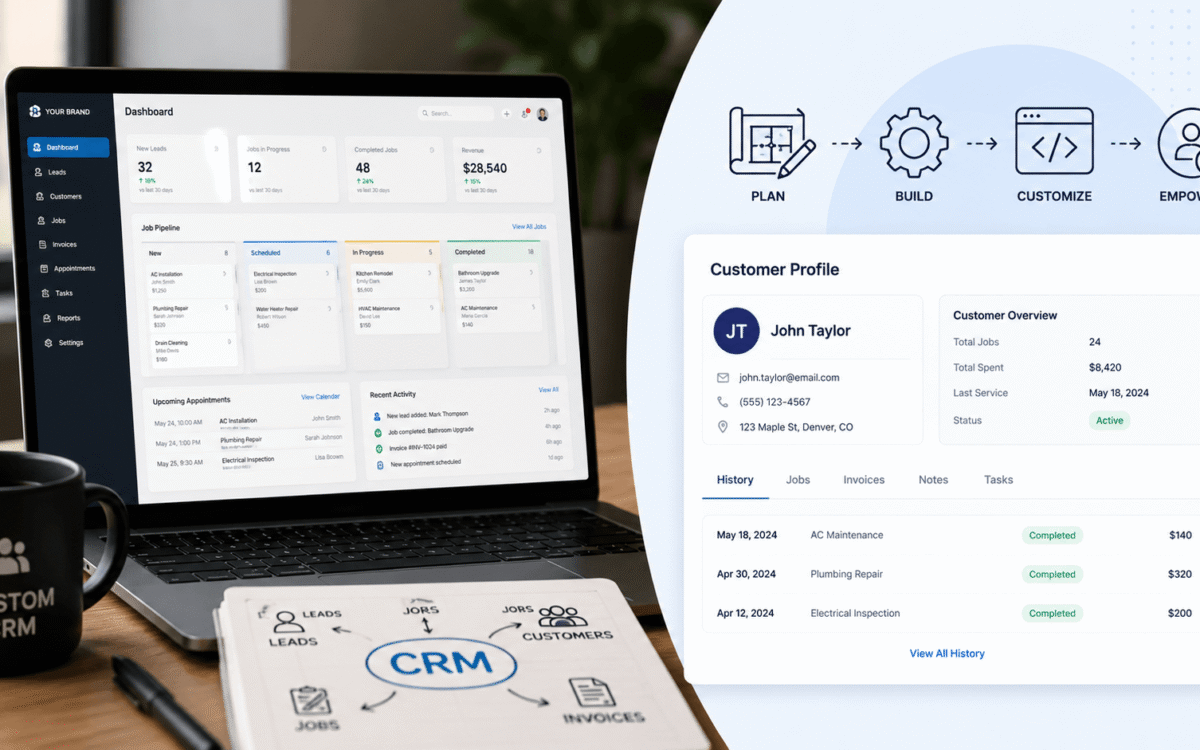
The new CRM provided a comprehensive customer profile that consolidated every interaction into a single location. Sales conversations, quotations, contracts, invoices, support requests, service records, and communication history became instantly accessible from one dashboard.
This centralized approach improved collaboration across departments and ensured that every employee had access to the information needed to provide exceptional customer service.
For service businesses that rely heavily on long-term client relationships, having a complete view of the customer journey can significantly improve customer retention and satisfaction.
Automating Business Processes to Improve Efficiency
Many service organizations spend a significant portion of their time performing repetitive administrative tasks. While these activities are necessary, they often prevent employees from focusing on higher-value responsibilities.
To address this challenge, we developed a workflow automation engine that streamlined many routine processes.
When a new lead entered the system, the CRM automatically evaluated predefined business rules and assigned the enquiry to the appropriate team member. Follow-up reminders were generated automatically, appointment notifications were scheduled without manual intervention, and escalation alerts were triggered whenever service commitments were at risk.
The automation engine also helped standardize internal processes. Employees no longer needed to remember every task or manually track every customer interaction because the system actively guided them through each stage of the workflow.
This not only improved operational efficiency but also ensured a more consistent experience for customers.
Leveraging Data and Analytics for Better Decision Making
One of the most common challenges faced by growing service businesses is the lack of actionable business intelligence.
Many organizations collect large amounts of data but struggle to convert that information into meaningful insights. Management teams often rely on spreadsheets and manually generated reports, making it difficult to quickly identify trends and opportunities.
To solve this issue, we developed a comprehensive reporting and analytics module.
Executives gained access to real-time dashboards displaying key performance indicators such as lead conversion rates, revenue growth, customer retention metrics, service delivery performance, and employee productivity.
These insights enabled leadership teams to make informed decisions based on accurate data rather than assumptions. The ability to monitor business performance in real time also allowed the organization to identify operational issues before they became larger problems.
As a result, decision-making became faster, more strategic, and more aligned with business objectives.
Prioritizing Security and Compliance
Because CRM systems store sensitive customer and business information, security was a critical component of the development process.
From the outset, we implemented multiple layers of protection designed to safeguard data and ensure regulatory compliance.
The platform incorporated secure authentication mechanisms, role-based access controls, encrypted communications, and comprehensive audit logging. Sensitive information was protected using industry-standard encryption protocols both during transmission and while stored within the database.
The client also operated across multiple regions, making regulatory compliance an important consideration. The CRM was developed with support for GDPR requirements in the United Kingdom, CCPA requirements in the United States, privacy regulations in Australia, UAE data protection frameworks, and India’s Digital Personal Data Protection Act.
By incorporating security and compliance considerations early in the project, we helped reduce risk while building trust with customers and stakeholders.
Supporting Service Businesses Across Global Markets
Although service businesses share many common operational challenges, different regions often have unique requirements and expectations.
In the United States, organizations frequently prioritize lead management, sales automation, and customer segmentation to support large-scale marketing campaigns and high enquiry volumes.
Businesses in the United Kingdom often focus on compliance, customer communication tracking, and detailed reporting capabilities that support professional services industries.
Organizations in Dubai and across the UAE increasingly seek digital solutions that support rapid growth, multilingual communication, and seamless integration with modern business ecosystems.
Australian companies often require strong mobile accessibility and workforce management capabilities to support geographically distributed teams.
Meanwhile, businesses in India frequently invest in automation and operational efficiency to support rapid expansion while maintaining service quality.
A custom CRM designed around these market-specific requirements can provide significant advantages over generic software platforms.
Business Outcomes After Implementation
Technology investments should ultimately be measured by their impact on business performance.
Following deployment of the CRM, the client experienced noticeable improvements across several key areas. Lead response times decreased significantly because enquiries were automatically routed to the appropriate teams. Customer communication became more consistent due to automated workflows and centralized information management.
Employees spent less time performing administrative tasks and more time engaging with customers. Managers gained real-time visibility into business performance, enabling faster decision-making and better resource allocation.
Perhaps most importantly, the organization established a scalable operational foundation capable of supporting future growth without requiring major process changes.
The CRM evolved from being a customer management tool into a strategic business asset that supported every stage of the customer journey.
The Future of CRM Development for Service Businesses
The CRM landscape continues to evolve as artificial intelligence, machine learning, and predictive analytics become increasingly integrated into business operations.
Modern CRM platforms are no longer limited to storing customer information. They are becoming intelligent systems capable of predicting customer behavior, identifying sales opportunities, recommending next actions, and automating increasingly sophisticated workflows.
AI-powered assistants, predictive lead scoring, customer behavior analysis, and conversational interfaces are expected to become standard features in future CRM solutions.
For service businesses operating in competitive markets such as the USA, UK, UAE, Australia, and India, investing in scalable and intelligent CRM platforms will be essential for maintaining efficiency and delivering exceptional customer experiences.
Organizations that embrace these technologies today will be better positioned to compete and grow in the years ahead.
Conclusion
Building a custom CRM is far more than a software development project. It is a strategic investment that helps service businesses improve operational efficiency, strengthen customer relationships, and support long-term growth.
Our experience developing this CRM demonstrated that the most successful solutions are designed around real business needs rather than generic software functionality. By combining modern technologies, workflow automation, advanced analytics, strong security practices, and scalable architecture, we created a platform that transformed the way the organization managed its customers and operations.
As businesses across the United States, United Kingdom, Dubai, Australia, and India continue their digital transformation journeys, custom CRM solutions will play an increasingly important role in driving efficiency, improving customer experiences, and creating sustainable competitive advantages.
For organizations seeking greater visibility, automation, and scalability, a CRM designed specifically for their business model can become one of the most valuable investments they make.