



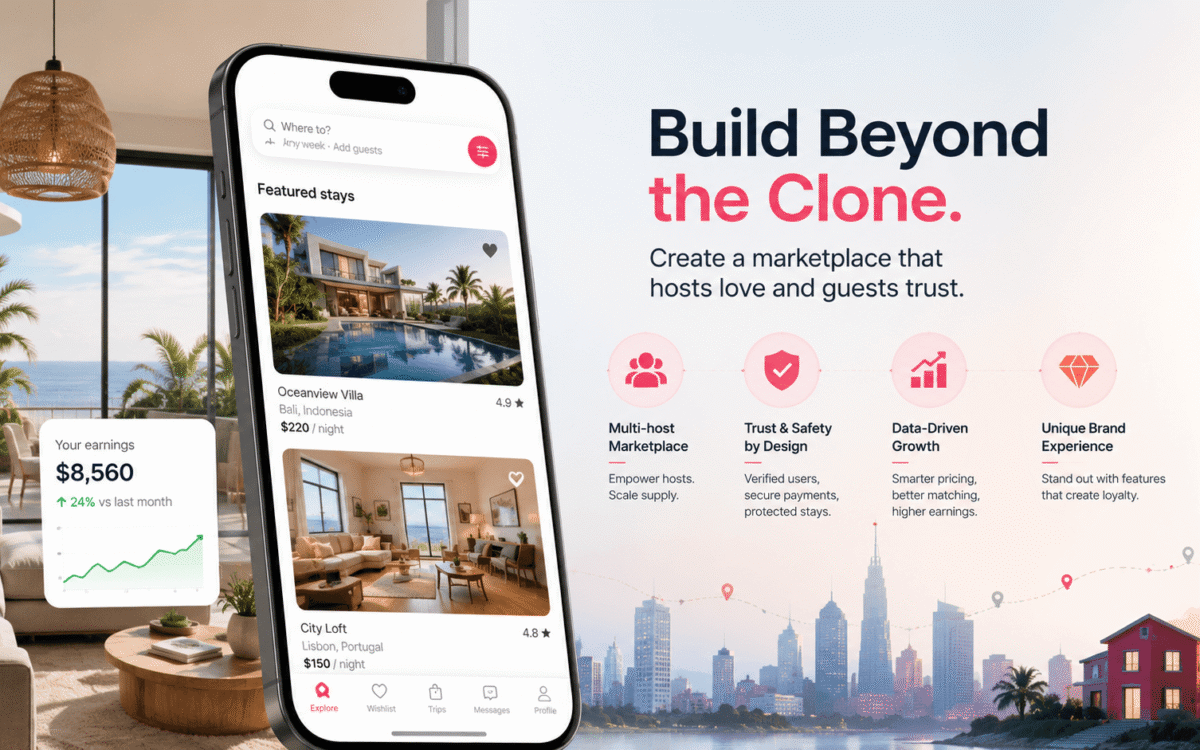
Every year, thousands of entrepreneurs and enterprises decide to build the next Airbnb.
Most fail.
Not because their technology is poor. Not because their mobile application lacks features. And certainly not because they chose the wrong development framework.
The real reason is far more fundamental: they build a platform before they build a marketplace.
This distinction matters.
Airbnb succeeded because it solved a trust problem between strangers long before it became a global technology company. The platform was simply the mechanism that enabled that trust to scale.
Today, businesses across the USA, UK, UAE, Australia, and India are exploring marketplace models to create new revenue streams, digitize traditional industries, and connect fragmented supply with growing demand. From vacation rentals and coworking spaces to equipment leasing, healthcare services, logistics, and professional consulting, the marketplace economy continues to reshape industries.
However, creating a successful Airbnb-style marketplace in 2026 requires more than replicating Airbnb’s interface or feature set.
It requires a carefully engineered ecosystem that balances technology, economics, operations, compliance, trust, and scalability.
This guide explores what businesses need to know before investing in marketplace development and how to build a platform designed for long-term profitability.
Why Marketplace Businesses Have Become So Attractive
Traditional businesses typically grow in a linear manner.
More customers require:
- More employees
- More infrastructure
- More operational expenses
Marketplace businesses operate differently.
They create value by facilitating transactions between suppliers and consumers.
As participation increases, the platform becomes more valuable to both sides of the network.
This phenomenon is known as a network effect.
The strongest marketplace businesses achieve:
- Lower customer acquisition costs over time
- Higher customer retention
- Recurring transaction revenue
- Strong market defensibility
- Global scalability
This explains why marketplace-based companies continue to dominate many sectors of the digital economy.

The Biggest Mistake Businesses Make When Building an Airbnb-Style Marketplace
Most organizations begin with a list of features:
- User Registration
- Search Filters
- Booking Engine
- Payment Gateway
- Messaging System
While these features are important, they are not what determine success.
The first question every marketplace should answer is:
How will supply and demand reach equilibrium on the platform?
Without sufficient suppliers, customers leave. Without sufficient customers, suppliers leave.
This challenge is known as marketplace liquidity.
Successful marketplace development should begin with business model validation rather than software development.
Before writing a single line of code, businesses should validate:
Supplier Acquisition Strategy
How will providers join the platform?
Demand Generation Strategy
How will customers discover the marketplace?
Revenue Model
How will the platform generate sustainable profits?
Retention Strategy
Why will users return instead of choosing a competitor?
Technology should support these answers—not replace them.
The Architecture Decisions That Determine Long-Term Success
Many marketplace platforms perform well during launch but struggle as user activity increases.
The reason often lies in architectural decisions made during the first few months of development.
Stage 1: MVP Architecture
For early-stage businesses, simplicity wins.
A monolithic architecture built with technologies such as:
- Next.js
- Node.js
- PostgreSQL
The objective at this stage is validation, not perfection.
Stage 2: Growth Architecture
As transaction volume increases, businesses should begin separating critical services, including:
- User Management
- Booking Engine
- Payments
- Search
- Notifications
This approach reduces system bottlenecks and improves long-term maintainability.
Stage 3: Enterprise Architecture
Large-scale marketplaces often adopt:
- Microservices
- Event-Driven Systems
- Containerized Deployments
- Kubernetes Orchestration
- Multi-Region Cloud Infrastructure
These approaches enable platforms to handle millions of transactions while maintaining performance, scalability, and reliability.
Building Trust: The Real Product of Every Marketplace
Marketplace founders often assume they are selling accommodations, rentals, services, or experiences.
In reality, they are selling trust.
Users are willing to transact with strangers only when strong trust mechanisms are in place. The most successful marketplaces invest heavily in building confidence between buyers and sellers.
Modern marketplaces establish trust through:
Identity Verification
Government-issued document verification helps confirm that users are who they claim to be.
Reputation Systems
Ratings and reviews increase transparency and enable users to make informed decisions.
Secure Payments
Escrow systems and protected payment processing reduce risk and create a safer transaction experience.
Transparent Communication
In-platform messaging and dedicated support channels encourage clear and secure interactions.
Fraud Prevention
AI-powered anomaly detection and behavioral monitoring help identify suspicious activity and protect users.
The stronger the trust layer, the stronger and more sustainable the marketplace becomes.
Global Opportunities for Marketplace Businesses
United States
The U.S. market continues to lead innovation in:
- Property Technology
- Healthcare Marketplaces
- Service Platforms
- Equipment Rental Ecosystems
Businesses that leverage AI-driven personalization gain significant competitive advantages in this market.
United Kingdom
The UK presents strong opportunities in:
- Professional Services Marketplaces
- Flexible Workspace Booking Platforms
- Experience-Based Marketplaces
Digital-first consumer behavior supports rapid adoption of marketplace solutions.
Dubai and UAE
Dubai’s smart city initiatives and strong digital economy investments are driving demand for:
- Luxury Rental Marketplaces
- Tourism Platforms
- Real Estate Marketplaces
- Mobility Solutions
The region’s high purchasing power makes it especially attractive for premium marketplace models.
Australia
Australian businesses are increasingly adopting marketplace solutions in:
- Construction Equipment Rentals
- Agriculture Technology
- Professional Services
Ongoing digital transformation initiatives continue to accelerate demand.
India
India represents one of the world’s fastest-growing marketplace opportunities due to:
- Expanding Internet Penetration
- UPI-Based Digital Payments
- Startup Ecosystem Growth
- Mobile-First Consumer Behavior
Hyperlocal and service-based marketplaces are particularly well-positioned for success.