Most businesses today are shifting away from traditional software patterns that follow fixed instructions. Today, they seek applications that can read data, identify patterns, and support better decisions. AI makes this possible by helping developers build software and define each product’s attributes. Common examples include automated workflows, predictive analytics, conversational assistants and personalized suggestions in apps used by both staff and customers.
AI works best when it solves specific business issues, not just because it’s popular. In this post, we’ll explore AI in custom software development and how it will shape how software is built and used across regular operations.
Where AI Helps During the Software Build
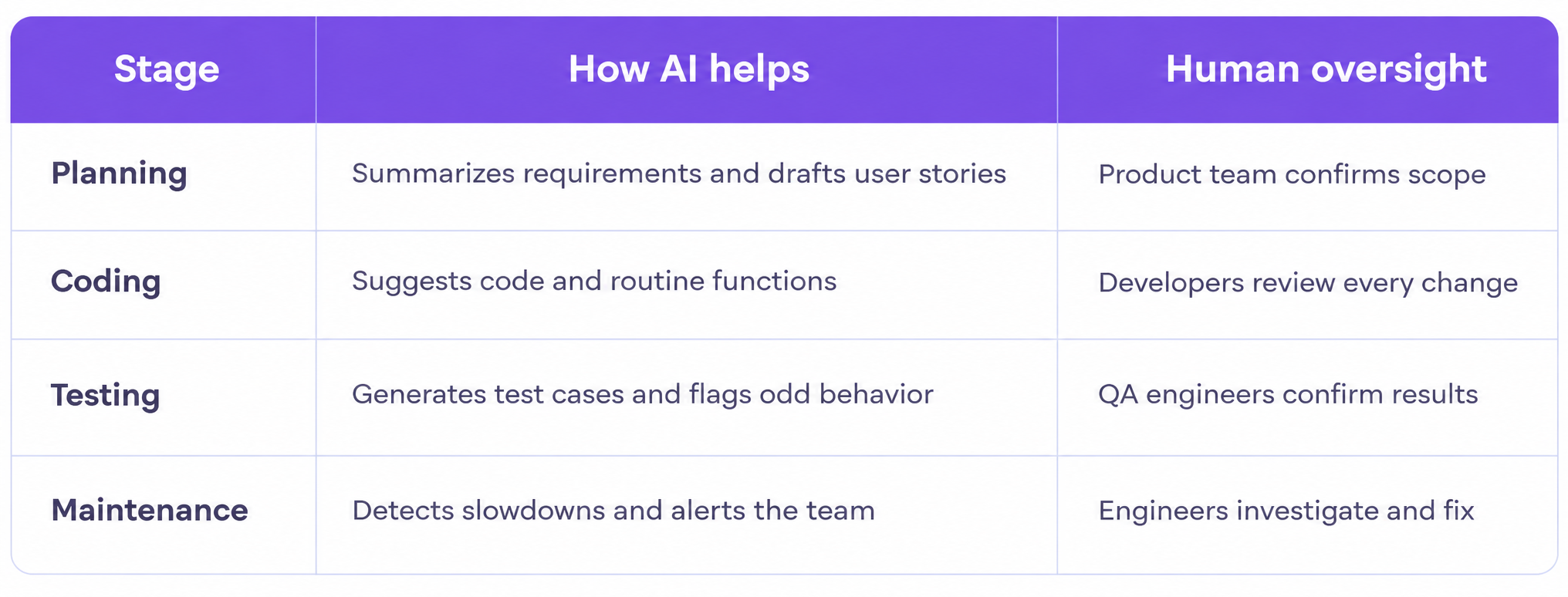
AI in software development helps at every stage, from planning and coding to testing and maintenance. The primary focus is to help teams work faster than expected while developers maintain technical control over design and quality.
Here are a few instances that reveal where AI supports development teams the most:
- AI coding assistants recommend code, generate scheduled functions, document existing code, and help developers find errors.
- Automation reduces time spent on repetitive tasks, letting developers focus on the framework and challenging business requirements.
- Generated code undergoes further review, testing and security inspections.
- AI-assisted tools generate test cases, flag unusual system behavior, and rank errors.
- Tools monitor performance and alert teams to issues before more users are affected.
AI-powered software development doesn’t stop at launch. Ongoing maintenance and quality assurance keep the tool accurate, secure and effective as software and data change.
Practical Ways AI Improves Custom Software
AI in custom software development works best when you take it step by step and scale each outcome.
Start With One Clear Business Problem
Optimal custom AI software development starts with a question, such as which task takes the most time or which decision needs better data. A small issue keeps risks, costs, and timelines easier to manage.
Here’s what to consider:
- Gradual and repetitive manual tasks
- Decisions involving better data management
- A clear and scalable success goal
- Data that one has already collected
- A well-named project owner
Any minor initial release proves the real value. Most founders can do this by building a fast MVP before adding any wider-scoped AI features.
Choose the Right Team for AI Work
AI-powered custom software requires people with strong knowledge of both the business and the data. Data experts, developers and product owners should all agree on a single goal before the actual work begins. This helps the system stay simple and easier to maintain right after launch.
Factors worth to look at:
- Developers who have experience with machine learning
- Product owners who understand their users
- Data experts in preparing inputs
- Clear mode of communication across various roles
- Shared timelines and business goals
The team’s overall structure directly affects cost and speed. Most firms will compare the cost of a dedicated team versus in-house SaaS development.
Add Conversational Assistants Where Users Need Help
Both virtual assistants and chatbots can answer common queries 24/7. A custom AI software development project would train them on your dedicated content, so replies align with your policies and products.
Typical aspects to include:
- Answering common support questions
- Ordering or booking status checks
- Lead capturing and intent qualification
- Handing off tasks to human staff
- Replies based on your brand voice
A chatbot will require links aligned with your systems. This is where an experienced AI integration company can help connect it to your existing CRM and help desk.
Personalize the User Experience
AI-powered custom software would study how people use an app and adjust accordingly. This involves product suggestions, content order and reminders that will keep every user engaged without any additional effort from your team’s end.
Best ways to personalize the entire user experience:
- Recommendations for every product or content
- Reminders that are scheduled based on user behavior
- Search outcomes that are ranked on relevancy
- Dashboards custom-made to roles
- Offers that are based on past activities
This is where personalization matters most, especially for subscription products, where retention drives revenue. This forms the primary part of AI SaaS product development.
Prepare Clean, Useful Data First
AI learns extensively through the details you feed it. So any messy or missing records would lead to weaker outcomes. Also review all the data you have, fix any gaps, and confirm whether or not you have permission to use it.
The following are the ways to ensure:
- Remove any duplicate or outdated records
- Filling every gap in primary fields
- Label examples based on training
- Confirming permission to use data
- Securing storage with clear ownership
Data-related tasks are often time-consuming. So, budget for it early to keep launch dates realistic.
Automate Workflows Beyond Simple Rules
Teams already using AI in software development can speed up testing, and the same idea applies to business operations. AI can help sort requests, extract data from documents and direct tasks without constant checks or manual effort.
What you need to do here is:
- Sorting out incoming requests for support
- Extraction of data from invoices
- Directing every task for rectifying staff
- Flagging items that need a thorough review
- Updating data without any manual entries
Plan every step like any release. Carefully planned AI-powered software development involves testing every automation before it touches live customer data.
Use Predictive Insights for Better Decisions
AI in custom software development can turn every stored data point into forecasts related to demand, churn rates, stock levels or maintenance needs. These predictions help managers act sooner and plan confidently, reducing reliance on assumptions.
It would generally include:
- Forecasting demand and sales
- Customers who’re likely to leave
- Stock levels before hitting shortages
- Issues with equipment before any breakdowns
- Risk scores involving approvals
Additionally, forecasts will improve as cleaner data arrives. Review them against real outcomes so you don’t overlook errors and drift.
Set Boundaries for Accuracy, Privacy, and Oversight
At times, AI can be wrong, and it should never replace any traditional functionalities. Also set clear limits on accuracy, safeguard personal data, and keep everyone involved in decisions that affect customers and funds, health, or safety.
Points to focus on:
- Accuracy in targets and test sets
- Privacy rules for every stored data
- Human reviews for primary decisions
- Access controls and comprehensive audit logs
- Plans for every model update
Clear boundaries make AI effective and trusted by staff and customers alike. Also review them regularly as laws, data, and business needs change.
How Mind Roots Builds Practical AI Software
Putting AI into software takes more than adding a tool. It needs clear goals, clean data, and careful testing from the start, so the result supports real business work. Mind Roots is a software development company that builds custom software, AI-powered applications, and workflow automation for startups, enterprises, and growing businesses, with a focus on practical results and clear communication.
Mind Roots can support your project with services such as:
- Custom software built around your own workflows and business goals
- AI features such as chatbots, machine learning, and predictive analytics models
- AI integration with the systems and tools you already use
- Web, mobile, and SaaS development handled by one team
Contact us today to discuss your requirements, explore our AI software development services, find the right starting point, and see how a first project could take shape.
Conclusion
AI is changing custom software by helping developers build faster, automating routine work, producing useful predictions, and making applications more responsive to each user. Its value comes from a defined purpose and clear limits for accuracy, privacy, and human oversight. The strongest results come from AI in custom software development that begins with one manageable use case.
Frequently asked questions
1. How Much Does It Cost to Add AI to Custom Software?
Costs depend on data quality, features, and integration effort. A small pilot with one use case gives you a realistic estimate before you invest more.
2. Do I Need a Lot of Data to Use AI?
Not always, since some tools use pre-trained models. The quality and relevance of your data matter more than sheer volume for most everyday business uses.
3. What Skills Does My Team Need to Manage AI Features?
Someone should understand your data and review results regularly. Basic training for staff using the new tools is usually enough for safe, regular day-to-day use.
4. How Long Does an AI Project Usually Take?
Timelines depend on scope and data readiness. A focused pilot is usually quicker than a full system, which needs more testing, data preparation, and review.
5. Will AI Replace My Developers or Software Team?
No, AI helps teams work faster but does not replace their judgment. People still set priorities, handle edge cases, and own the final business result.