A founder once slid a beautiful green circuit board across a coffee table to me. Four layers, a custom antenna, a battery connector sourced from Shenzhen. It had eaten seven months and most of his seed round, and he proudly called it his IoT MVP. When I asked how many customers had used it, he went quiet. The answer was zero.
That story isn’t rare. In CB Insights’ widely cited study of 101 startup post mortems, 42% of founders named “no market need” as a reason their company died. Hardware teams feel that pain harder, because every wrong guess gets soldered into place.
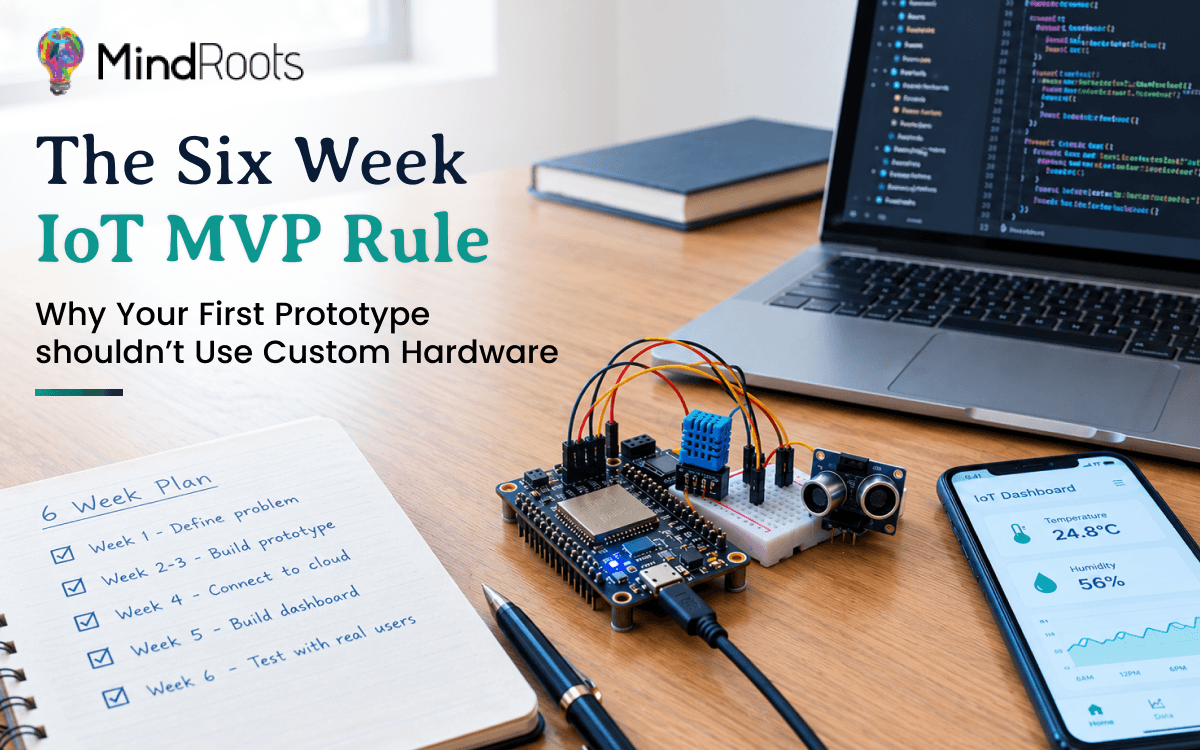
So here’s the rule I give every team building an IoT MVP: your first working prototype should take about six weeks and use zero custom hardware. Development boards, ready made sensor modules and an existing cloud platform will give you something real people can use.
That’s enough to test the problem, the user experience and the business model before you spend serious money on PCB design.
Why Custom Hardware Is a Trap for Your First IoT Prototype
Custom hardware is a trap for a first IoT prototype because it locks in expensive decisions before you have the evidence to make them.
The cost lands before a single customer does
A custom board isn’t one expense. For a first spin, you’re usually paying for:
- Schematic design and PCB layout
- Fabrication and assembly of a small batch
- Bring up and debugging when something doesn’t power on
- A second or third revision, each with weeks of waiting on fabrication and parts
In my experience, most teams need at least two board revisions before a design is stable. Each one costs money and, worse, weeks, while your competitors talk to customers.
Certification shows up early
If your board carries its own radio design, you’ll need regulatory testing before you can sell it. US test lab Compliance Testing lists FCC certification packages from roughly $3,000 to $15,000, depending on the device. SparkFun’s public write up on certifying its Artemis Bluetooth module put FCC Part 15 testing at about $4,000, with a five week wait for results. For further details, see the FCC Equipment Authorization guidance.
That’s money spent proving a device is legal before proving anyone wants it.
Sunk cost bias makes you defend bad decisions
Once you’ve poured six months into a board, you start protecting it. Feedback like “this should mount on the wall, not sit on a desk” feels like a threat instead of a gift. Cheap prototypes are easy to throw away, and that’s exactly why they’re valuable.
What the Six Week IoT MVP Rule Actually Means
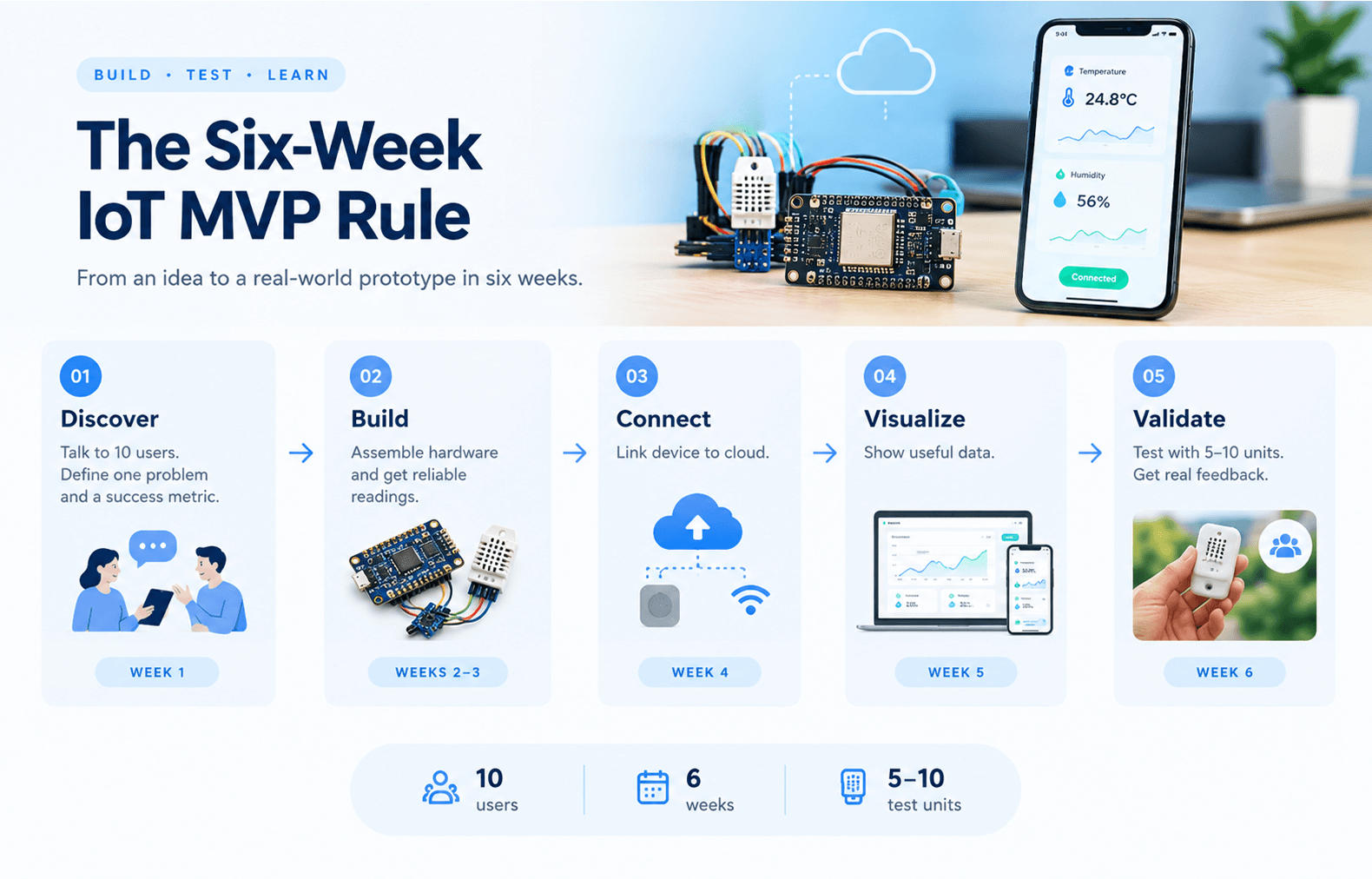
Week 1
Week 2 and 3
Week 4
Week 5
Week 6
Week 1: Define the problem, not the product
Spend the first week talking to at least ten potential users. Write down the single job your device must do and how you’ll measure success. If you can’t say it in one sentence, you’re not ready to order parts.
Weeks 2 and 3: Assemble the IoT prototype with development boards
Pick a main board, plug in sensor modules and get clean readings on a bench. A 3D printed or even cardboard enclosure is fine. Ugly is allowed. Unreliable isn’t.
Week 4: Firmware and cloud connection
Get data from your IoT MVP to a cloud platform, every time. Handle the boring stuff now, like reconnecting after a WiFi drop and over the air updates.
Week 5: Build the app or dashboard
Users don’t experience your sensor. They experience the alert, the chart or the weekly summary. A no code dashboard is plenty. Focus on the one screen that delivers your Week 1 promise.
Week 6: Test your IoT MVP with real users
Put five to ten units in real homes, farms or factories. Watch how people install them, where they place them and when they stop opening the app. Then make the call: pivot, push on or stop.
The Off the Shelf Toolkit for Fast IoT Product Development
The best toolkit for an IoT MVP is the one with a big community, solid documentation and parts you can buy this week.
Development boards worth starting with
- ESP32: cheap, WiFi and Bluetooth built in, and a huge community. My default for most consumer devices.
- Raspberry Pi: a full Linux computer for cameras and heavier processing.
- Arduino (Nano 33 IoT, Uno R4 WiFi): beginner friendly, with endless tutorials.
- Nordic nRF52840 DK and nRF9160 DK: the go to kits for low power Bluetooth and cellular IoT.
Sensor modules
Breakout boards from Adafruit, SparkFun, Seeed and DFRobot cover almost any measurement, and connector systems like Qwiic, STEMMA QT and Grove let you chain them without soldering.
Connectivity
WiFi suits most indoor products, Bluetooth Low Energy suits wearables, and LoRaWAN or cellular boards cover remote sites. IoT connectivity reporting from Mobile World Live reports that WiFi made up about 32% of IoT connections in 2025, with Bluetooth at about 24%.
Cloud IoT platforms
AWS IoT Core, Azure IoT Hub, ThingsBoard, Blynk and Particle all handle device connections, data storage and basic dashboards. Pick one and move on. Building your own backend in Week 4 is how six weeks becomes six months.
Off the shelf vs custom hardware at a glance
Factor
Off the Shelf Prototype
Custom Hardware Prototype
What a Six Week IoT MVP Teaches You That Custom Hardware Can’t
A six week IoT MVP teaches you whether people want the outcome your device creates, which custom hardware is worst at teaching.
It shows how people really install the thing, which data they care about, and whether they’ll pay through a one time purchase or a subscription.
A 2017 Cisco survey of 1,845 IT and business decision makers found that 60% of IoT initiatives stalled at the proof of concept stage, and only 26% of companies had an IoT initiative they considered a complete success. A fast IoT MVP pulls those hard truths to the front, while they’re still cheap.
A tale of two hardware startups
Picture a smart pet feeder startup (a composite of teams I’ve seen). They spent eight months and much of their seed round on a custom board with a camera and a motorised hopper. In the first pilot, owners loved the camera and barely touched scheduled feeding, because a cheap timer feeder already did that. The expensive board was built around the wrong feature.
Now picture a cold chain monitoring team I’ll call FreshTrack. They wired an ESP32 to an off the shelf temperature probe, stuck it in a plastic box and pushed alerts through a cloud platform’s dashboard. In Week 6, pilot customers said the sensor mattered less than an automatic compliance report for food inspectors.
FreshTrack rebuilt the app in a week and started charging for the reports. They only designed custom hardware once paying customers asked for battery life the dev board couldn’t deliver.
When It Is Finally Time to Move to Custom Hardware
It’s time to move to custom hardware when you have validated demand and a specific limit that off the shelf parts can’t solve. Signs your IoT MVP has done its job:
- Validated demand: paying pilots, signed letters of intent or a waitlist that actually converts. Compliments don’t count.
- Unit cost pressure: at volume, dev board overhead eats your margin.
- Form factor needs: the product has to fit a wrist, a pipe or a light switch box.
- Power targets: battery goals that need tight component control.
- Funding to finish: enough runway for several board revisions plus certification.
Even then, start with precertified radio modules on your first custom board. Under the FCC’s modular approval rules, a module that’s already certified can shrink your own testing scope, cost and risk.
The prize is worth the patience. IoT Analytics’ report on the number of connected IoT devices counted 18.5 billion connected IoT devices at the end of 2024, expected 21.1 billion by the end of 2025 and projects 39 billion by 2030.
Common IoT MVP Mistakes to Avoid
The most common IoT MVP mistake is building for scale before you’ve earned the right to. The rest are variations on it:
- Chasing battery life too early. Plug it into the wall unless long battery life is the actual promise.
- Writing your own cloud backend. Use a platform. Nobody buys a product for its message broker.
- Skipping security basics. Unique device credentials and encrypted connections cost little, even on a prototype.
- Testing only with friends. Friends are polite. Customers are honest.
- Polishing the enclosure first. A pretty box around the wrong experience is still the wrong experience.
Build the Cheap Version First
Custom hardware is where great connected products end up. It’s rarely where they should start. Give yourself six weeks, a box of dev boards and a stubborn focus on real users, and you’ll learn more than a year of PCB revisions would.
Your next step: write down the one problem your device solves, in one sentence, today. Then order an ESP32 or Nordic dev kit and block out six weeks.
By the end, you’ll have a working IoT MVP, real user feedback and the evidence to decide what comes next. Want a second pair of eyes on your plan? Share your six week roadmap in the comments and I’ll tell you what I’d cut.