



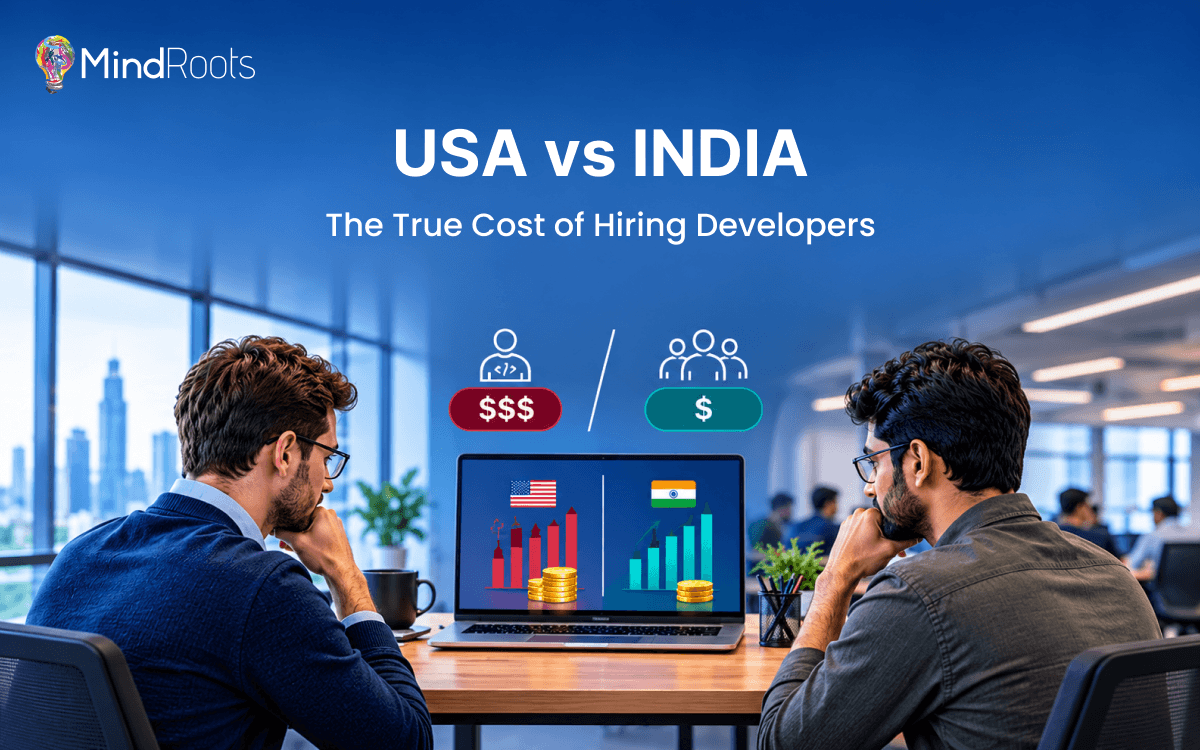
You have a product roadmap, a launch date, and a budget that looked fine until you priced your first senior engineer. Then the recruiter quoted a placement fee, the candidate wanted equity, and your top pick accepted a counteroffer three weeks later. Sound familiar?
That experience is why so many US founders now ask whether they should outsource software development to India instead of hiring locally. It is a fair question, and it deserves a straight answer rather than a sales pitch.
This guide breaks down the true cost of a US hire, what an Indian team really costs, where quality concerns come from, and when hiring at home is still the right move. We have sat on the delivery side of this decision for more than 15 years at Mind Roots, so we will be upfront about the tradeoffs.
The True Cost of Hiring a Developer in the USA
When people search for the cost to hire a developer in USA, they usually find a salary figure and stop there. Salary is only the starting point.
Base Salary
According to the US Bureau of Labor Statistics, the median annual pay for software developers was $135,980 in May 2025. Senior engineers in major technology markets such as San Francisco, Seattle, and New York can command substantially higher compensation, particularly when bonuses and stock awards are included.
Benefits and Payroll Taxes
As an employer, you pay 6.2% in Social Security taxes and 1.45% in Medicare taxes on applicable wages. For 2026, the Social Security wage base limit is $184,500, while Medicare has no wage base limit. Federal and state unemployment taxes may also apply.
Health insurance, retirement matching, and paid time off come on top. BLS employer cost data shows that benefits accounted for 30% of total compensation for private industry workers in June 2026. This is an economy-wide average rather than a software-specific figure, so your actual costs will depend on your benefits package and employment arrangements.
Recruiting, Equipment, and Onboarding
Recruitment costs depend on how you source candidates. Using an external recruitment agency can add placement fees, while an internal hiring process still requires time for sourcing, interviews and candidate evaluation. Add a laptop, software licenses, and the time a new hire needs before they are fully productive.
Time to Hire and Turnover
Hiring timelines vary depending on the role, seniority, location and availability of qualified candidates. Senior engineering positions can require additional time for technical assessments, interviews and negotiations. If that person leaves, you may need to repeat the recruitment process and absorb additional costs through replacement hiring, onboarding and lost momentum.
Put it together and the true cost of employing a software developer goes well beyond the advertised salary. Benefits, payroll taxes, recruitment, equipment and onboarding all contribute to the final figure. The exact first-year cost will depend on the compensation package, hiring approach and location. That is one person, before you add design, QA, or project management.

What It Really Costs to Outsource Software Development to India
Indian rates vary with experience and company maturity. Freelancers on marketplaces can be cheaper, but most businesses that need dependable delivery work with an established Indian software development company.
Typical indicative ranges in 2026 look like this:
- Hourly rates: about $25 to $50 per hour for developers working through established software development companies, depending on experience and specialisation.
- Monthly dedicated developer: roughly $3,000 to $6,000 per month for full-time work, depending on seniority, technical skills and the engagement model.
- Small dedicated team (two developers, one QA engineer, plus part-time design and project management): often $10,000 to $20,000 per month, depending on team composition and delivery responsibilities.
The bigger difference is what comes included. When you hire Indian developers through an established company, the monthly fee may cover:
- Recruitment, payroll, benefits, and local compliance
- Office space, hardware, and software licenses
- QA testing and peer code reviews
- A project manager and regular progress reports
- UI and UX design support when you need it, depending on the engagement
- A replacement if a team member leaves, subject to the company’s replacement policy and contract terms
You are not just paying for code. You are paying for a working delivery system that someone else maintains.
Side by Side Comparison
Factor
US In House Developer
Dedicated Indian Team
Does Quality Suffer? An Honest Answer
Let us address the fear directly. Yes, some outsourcing projects go badly. Missed deadlines, messy code, and vague status updates are real, and plenty of founders have a story to tell.
But the cause is rarely geography. It is usually one of three things: picking the cheapest bid, hiring a team with no process, or handing over a project without clear requirements. A weak team in Austin produces weak software too.
A mature Indian company reduces those risks with structure:
- Code reviews: a senior engineer reviews every pull request before it merges.
- Dedicated QA: testers write test cases, run regression checks, and catch bugs before your users do.
- Transparent reporting: you see the sprint board, daily updates, and demo builds, so progress is never a mystery.
- Clear ownership: you get repository access from day one, so the code is always yours.
India also graduates a huge number of engineers every year, and many senior developers there have spent a decade building products for US, UK, and Australian clients. The talent exists. Your job is to pick a partner whose process you can see and verify.
The Time Zone Advantage
Most people treat the time difference as a drawback. Used well, it works in your favor.
India Standard Time is 10.5 hours ahead of US Eastern Standard Time and 13.5 hours ahead of Pacific Standard Time. The gap shrinks by one hour during US daylight saving time.
That creates an overnight development cycle. You review work and leave feedback at the end of your day. Your Indian team picks it up in their morning, builds and tests, and you wake up to progress. A bug reported at 5 PM in New York can be fixed before your first coffee.
Good teams also plan overlap. A team working 1 PM to 10 PM IST stays online until 11:30 AM Eastern, which gives East Coast clients a comfortable morning window for standups and calls. West Coast clients usually get an early morning slot, with the Indian project lead taking a later evening call when needed.
When Hiring in the USA Still Makes Sense
An honest comparison has to admit where a local hire wins. Two situations stand out.
First, your core technical leader. A CTO or founding engineer who sets architecture, shapes company culture, and speaks to investors should usually sit close to you. Second, work with strict residency or on-site rules, such as certain government, defense, or regulated healthcare projects that require US-based staff.
Even then, many companies pair one strong US lead with a dedicated development team in India. The local lead owns the vision, and the Indian team supplies the build capacity. That hybrid often beats either option on its own.
How to Choose the Right Indian Development Partner
Type “offshore development team India” into Google and you will find thousands of options. Use this checklist to narrow them down:
- Proven track record: ask for case studies in your industry, not just a wall of logos.
- Verified reviews: read detailed client feedback on Clutch, GoodFirms, and Upwork.
- Technical vetting: let your own engineer interview the developers who will actually work on your project.
- Defined process: ask how sprints, demos, and scope changes are handled.
- Separate QA: testing should be its own role, not something developers squeeze in.
- Communication plan: confirm overlap hours, a named project manager, and expected response times.
- IP and NDA terms: make sure the contract assigns all code and IP to you.
- Security practices: check access control, repository security, and data handling policies.
- Flexible engagement: you should be able to scale the team up or down without penalties.
- A small first milestone: start with a defined piece of work before you commit long term.
Why US Businesses Choose Mind Roots
Mind Roots has designed and built software since 2010. Over more than 15 years, our team of 80+ developers, designers, and QA engineers has delivered over 600 projects for startups and growing businesses.
We build custom software, web and mobile apps, SaaS products, AI solutions, and AI agents. Many US clients start with MVP development to test an idea quickly, then move to a dedicated development team as the product grows.
You do not have to take our word for it. Mind Roots is Top Rated on Upwork and listed on Clutch and GoodFirms, where clients describe our work in their own words. With headquarters in Zirakpur, Punjab, and an office in Rockdale, NSW, Australia, we are used to working across time zones and keeping clients informed every day.
Conclusion: Build More With the Budget You Have
Hiring in the USA makes sense for a few key leadership roles and for projects with strict residency rules. For almost everything else, the numbers and the process favor a dedicated Indian team. You get faster hiring, built-in QA, flexible scaling, and an overnight development cycle, often for a fraction of the cost of one local hire.
The real risk is not the decision to outsource software development to India. It is choosing the wrong partner. Use the checklist above, ask hard questions, and start with a small milestone.
If you are ready to see what your project would cost, Mind Roots can help. Request a free project cost estimate or book a 30-minute consultation with our team. We will review your idea, suggest the right team size, and give you a clear, honest quote.
Frequently Asked Questions
Most established Indian software development firms charge around $25 to $50 per hour. A full-time dedicated developer may cost roughly $3,000 to $7,000 per month, depending on experience level, technology stack, and engagement model. Fees may include QA, project management, hardware, and HR overhead, but these inclusions vary by provider and should be confirmed before signing a contract.
Yes, in most cases. A US software developer earning the median annual salary of $135,980 can cost an employer approximately $194,000 per year once average benefits and employer compensation costs are included, before additional recruitment and equipment expenses. A comparable Indian developer through an established company may cost significantly less, often around $36,000 to $84,000 annually, depending on experience and engagement model. QA and project management support may also be included, depending on the agreement.