



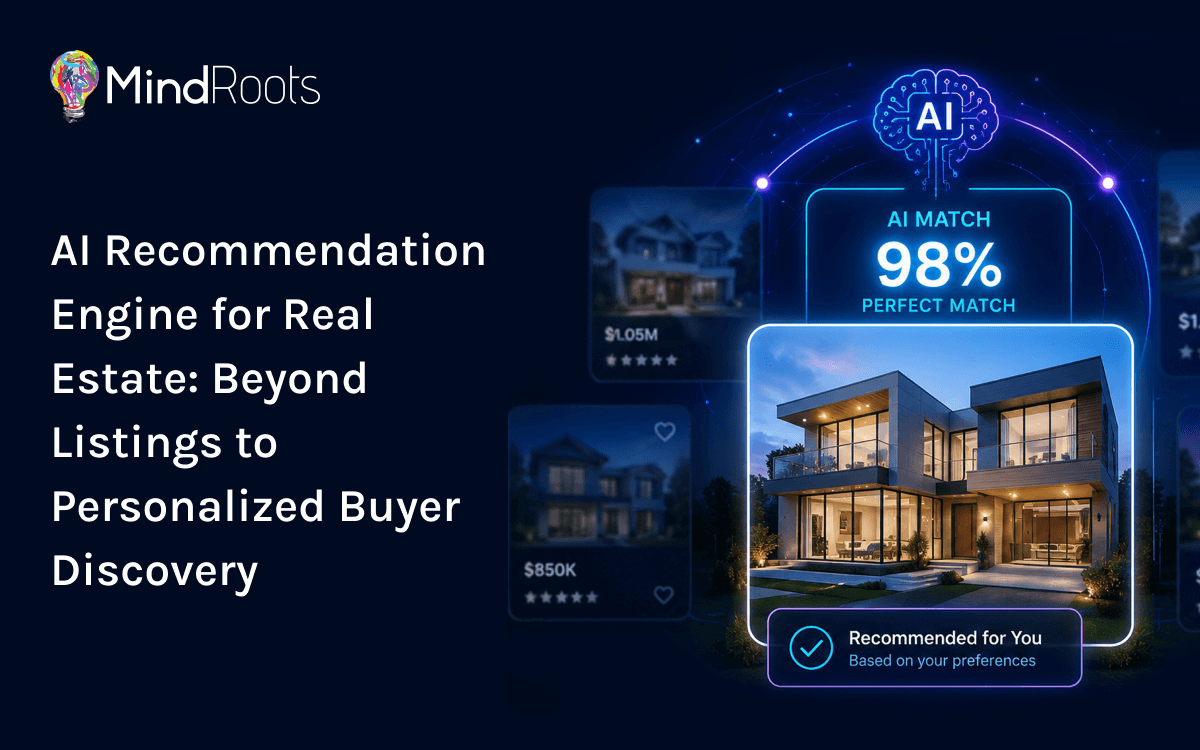
A buyer opens your portal, types “3BHK near good schools,” gets 400 results sorted by price, and closes the tab. Three minutes later, they’re on a competitor’s app that already knows they browsed gated communities last week, spent 40 seconds lingering on a listing near a top rated school, and never once clicked “view all amenities.” That platform doesn’t just show listings, it makes a recommendation. And it just won a lead you paid to acquire.
This is the quiet crisis facing real estate portals and brokerage platforms today. Filters and keyword search were built for a world where buyers knew exactly what they wanted and had the patience to sift for it. Neither is true anymore. Buyers browse the way they shop on Amazon or scroll on Netflix, expecting the platform to understand intent, not just match strings. For brokerage founders and proptech leaders, the question is no longer whether to adopt AI driven personalization, but how fast you can engineer it before your competitors do.
Why Static Search Is Losing Buyers
Traditional listing portals operate on a simple premise: buyers self select using filters, city, price range, bedrooms, property type, and the system returns everything that matches. The logic is transactional, not relational. It has no memory of what the buyer did five minutes ago, no understanding of why they rejected twelve listings and saved two, and no ability to infer unstated preferences like commute tolerance or amenity priorities.
The result is measurable business damage:
- Choice overload, hundreds of undifferentiated results push buyers to abandon search rather than refine it further.
- Zero behavioral memory, every session starts from scratch, wasting the signal generated by prior visits.
- Poor lead qualification, agents receive inquiries with no context on true buyer intent, wasting follow up cycles on low fit leads.
- No handling of natural intent, a query like “family home, walkable, under budget, quiet street” simply cannot be expressed through checkboxes.
Buyers aren’t leaving because inventory is bad. They’re leaving because discovery is dumb.

What an AI Recommendation Engine Actually Means Here
An AI recommendation engine is not a smarter search bar, it’s a personalization layer that sits on top of your inventory and continuously learns each buyer’s evolving preferences to surface the properties most likely to convert them. Where search answers “what matches these filters,” a recommendation engine answers “what should this specific person see next, and why.”
In practice, this means the system ingests both explicit signals (filters set, budget entered) and implicit signals (dwell time, scroll depth, repeat views, saved searches, rejected listings) to build a continuously updating buyer profile, then matches that profile against a rich representation of every property in inventory, not just its listed attributes but its “personality” relative to buyer behavior patterns.
Core Technical Architecture
Building this well requires marrying several distinct machine learning approaches, not picking one silver bullet algorithm.
Filtering Approaches: Collaborative, Content Based, and Hybrid
Content based filtering recommends properties similar to ones a buyer already engaged with, based on shared attributes, price band, square footage, locality, amenities, builder reputation. It works well from day one but struggles to surprise the buyer with adjacent options they hadn’t considered.
Collaborative filtering looks at patterns across many buyers, “buyers who viewed and saved properties like yours also converted on properties like this”, capturing preferences that attribute data alone can’t express, such as neighborhood vibe or resale sentiment. Its weakness is the cold start problem: it needs volume before it becomes useful.
Hybrid models blend both, typically weighting content based signals heavily for new users and shifting toward collaborative signals as behavioral history accumulates. Most production grade real estate recommendation systems today are hybrid by default.
Feature Engineering: The Real Differentiator
The quality of any recommendation engine is bounded by the quality of its features, not the sophistication of its algorithm. Real estate feature engineering typically spans:
- Property attributes, configuration, carpet area, floor, age, orientation, builder track record
- Geolocation features, proximity to schools, transit, hospitals, employment hubs, computed as distance decayed scores rather than raw coordinates
- Price elasticity signals, how a buyer’s engagement changes as listings move above or below their stated budget
- Amenity scoring, weighted importance of amenities inferred from click and save patterns, not just presence or absence
- Buyer behavior signals, dwell time, scroll depth, comparison patterns, saved search frequency, revisit intervals
Vector Embeddings and Similarity Search
Modern engines represent both properties and buyer preferences as vector embeddings, dense numerical representations that capture semantic similarity, not just exact attribute matches. A buyer who repeatedly engages with quiet, low density, greenery adjacent listings develops a preference vector that sits “close to” similar properties in vector space, even if those properties differ on paper (different builder, different micro market). Retrieval then happens via cosine similarity or approximate nearest neighbor search across the property vector index, enabling sub second personalized ranking even against large inventories.
Real Time Behavioral Tracking
Recommendations degrade quickly if they rely only on batch processed history. A production system needs real time clickstream ingestion, dwell time, scroll depth, saved searches, comparison actions, feeding a low latency feature store so that a buyer’s current session immediately influences what they see next, not just their history from last month.
LLMs for Natural Language Query Understanding
Large language models now let buyers query in plain language, “3BHK near good schools under budget”, and have that intent decomposed into structured constraints (configuration, school proximity threshold, price ceiling) that feed the retrieval and ranking layers. This closes the gap between how buyers actually think and how databases are structured.
Data Pipeline Basics
Underneath all of this sits unglamorous but essential infrastructure:
- ETL pipelines, that continuously pull from your MLS/CRM, listing management system, and behavioral event logs
- A feature store, that serves consistent, versioned features to both training and real time inference
- Model retraining cadence, typically weekly or biweekly full retrains, with lightweight real time re ranking layered on top for session level adaptivity
Business Impact: Why This Pays for Itself
The financial case is not speculative. Personalization directly attacks the metrics that determine platform profitability:
- Higher conversion rates, buyers act faster on recommendations that already fit inferred preferences
- Reduced drop off, fewer abandoned sessions from filter fatigue and choice overload
- Better lead qualification, agents receive leads scored by genuine engagement depth, not just form submission
- Improved agent productivity, less time chasing cold inquiries, more time closing warm, prequalified ones
- Competitive differentiation, in a market where most portals still run on 2015 era filter logic, a genuinely personalized experience becomes a retention moat
Implementation Roadmap for Business Owners
You don’t need a research lab to get started, but you do need sequencing discipline.
- Audit data readiness, Do you have clean, structured MLS/CRM data and reliable behavioral event tracking? Most platforms underestimate how much cleanup this requires.
- Start with an MVP, Launch content based recommendations first (fastest to build, least dependent on volume), then layer in collaborative filtering as usage scales.
- Decide build vs. buy, Off the shelf recommendation platforms accelerate time to market but limit differentiation; in house builds cost more upfront but compound as a defensible asset. Many mid market players choose a hybrid: licensed vector search infrastructure with proprietary feature engineering on top.
- Integrate deeply with CRM and MLS, The engine is only as good as the data pipeline feeding it; treat this integration as core infrastructure, not an afterthought.
- Instrument for measurement from day one, Conversion lift, session depth, and lead quality scores should be tracked against a control group, not assumed.
Common Pitfalls to Avoid
- The cold start problem, new users and new listings have no history; mitigate with strong content based fallbacks and onboarding preference surveys.
- Data privacy exposure, behavioral tracking must be built with consent and regulatory compliance (e.g., data localization, opt outs) as first class requirements, not retrofits.
- Overfitting to short term behavior, a buyer browsing luxury listings out of curiosity shouldn’t permanently skew their profile; use decay functions and explicit feedback to correct drift.
- Bias in recommendations, models trained on historical engagement can inadvertently reinforce steering patterns; audit outputs regularly across price bands and locality types.
The Competitive Window Is Closing
Recommendation engines have already redefined ecommerce, streaming, and travel booking. Real estate is next, and the platforms that move first will accumulate the behavioral data advantage that makes their systems progressively harder to compete with. Waiting for the technology to “mature” simply means waiting for competitors to build the moat first.
If you’re evaluating this investment, start with a data readiness audit and a scoped MVP, not a multi year platform overhaul. The businesses winning this shift aren’t the ones with the most sophisticated models; they’re the ones who started learning from their buyers earliest.
Frequently asked questions
6. Is WordPress still good for SEO in 2026?
Yes, arguably better than most alternatives. WordPress SEO benefits from mature plugins, customizable structure, and full control over technical elements like page speed and schema markup.
Related News


Building an AI Quiz & Learning Platform for Kids