



Eight months. A six figure invoice. And a forecasting tool that got 60% of the job done.
That’s roughly where a mid sized logistics company we spoke with last year found themselves after buying an off the shelf AI forecasting platform. It handled most of their SKUs just fine. The remaining 40% had ordering patterns the tool had simply never seen before, and no amount of tweaking fixed that. They ended up building a custom layer on top of it anyway. So much for the shortcut.
That’s the build vs. buy question in a nutshell. It’s rarely all or nothing, and getting it wrong costs you either way, just in different currencies. One path drains your budget. The other drains your timeline and your patience.
Why This Decision Matters More Than It Used To
Not long ago, this wasn’t really a decision at all. If you wanted AI in your business, you built it, because there wasn’t much on the shelf worth buying. That’s changed fast. Chatbots, forecasting engines, content generators, document processors, there’s a vendor for nearly everything now, and most of them look impressive in a sales deck.
Which is great, honestly. It’s also part of the problem. Companies are making this call more often, with less time to think it through, and usually without anyone in the room asking the right questions first.
Lean too far toward buying and you end up with three or four disconnected tools stitched together, none of them scaling, all of them quietly becoming someone’s Friday afternoon headache. Lean too far toward building and you’ve spent real money on custom AI development for a problem a $200 a month subscription would have handled just as well.
When Off the Shelf AI Tools Are the Right Call
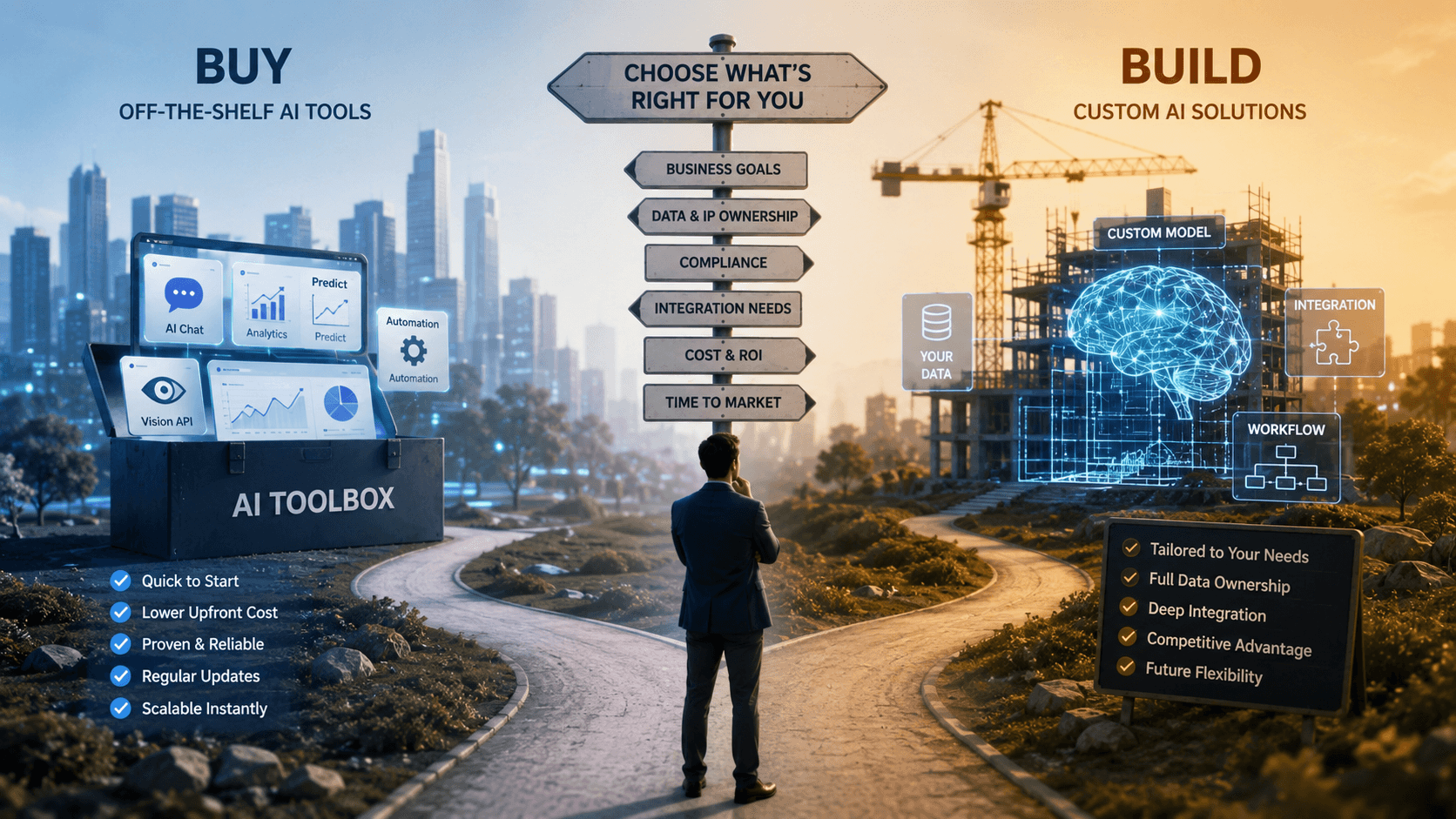
Here’s something worth saying plainly: buying isn’t the consolation prize. For a lot of companies, it’s genuinely the smarter move. Off the shelf AI tools make sense when a few things are true.
Your use case isn’t special, and that’s fine.
Customer support chatbots, transcription, basic image recognition, standard OCR. These problems have been solved thousands of times by people with bigger budgets than yours. Let them maintain it.
You need this running now, not next quarter.
If the AI capability itself won’t be what sets you apart from competitors, speed should win. Buy it, ship it, move on.
Nobody on your team can maintain a model after launch.
I’ve watched companies commission custom AI development, get a working system, and then have no one who understands it well enough to touch it six months later. That’s not a technology problem. That’s a staffing problem wearing a technology costume.
Your budget can absorb a subscription but not a maintenance team.
Off the shelf pricing is predictable, month after month. Custom systems come with retraining, monitoring, and infrastructure costs that never show up on the first invoice. They show up quietly, later, when you’re least prepared for them.
When Custom AI Development Actually Pays Off
Custom AI development earns its price tag when the problem you’re solving belongs to you, not to a generic version of your industry.
Your data or your workflow genuinely doesn’t look like anyone else’s.When your terminology, your customer behavior, or your operational quirks don’t match what a general purpose model was trained on, you’ll spend more time fighting the tool’s assumptions than you would have spent building around your own.
The AI is the product, not a feature bolted onto the product.If your edge depends on doing something better than everyone else, sharper fraud detection, smarter pricing, cleaner matching, then a tool your competitors can rent for the same monthly fee will never get you there.
Data ownership and compliance actually keep someone up at night.In healthcare, finance, and legal work, where data residency and model transparency carry real weight with regulators, off the shelf tools can create audit problems that custom AI solutions are designed to sidestep from the start.
You need this woven into your systems, not sitting beside them.Off the shelf tools are built for the average customer, which means they’re built for nobody in particular. If your AI has to sit inside a proprietary workflow and talk to five internal systems that change every quarter, custom development stops being a nice to have. It becomes the only thing that actually holds up.
A Practical Framework: Ask These Six Questions
Before you sign anything or greenlight a sprint, sit with these:
1. Does this differentiate us, or just support us?Differentiators are usually worth building. Support functions are usually worth buying.
2. Who owns the data, and does that ownership actually matter here?If regulatory exposure or IP protection is in play, that tilts the scale toward build.
3. What does this cost in three years, not three months?Subscriptions compound. So does the cost of keeping custom infrastructure alive. Model both honestly.
4. Will an off the shelf tool integrate cleanly, or will we be forcing a square peg through it for the next two years?
5. Are we willing to build the internal muscle to maintain a custom system, or are we hoping it maintains itself?It won’t.
6. How fast is this space moving?Locking into a rigid custom build too early, in a field where the underlying models change every few months, can backfire just as badly as buying too hastily.
There’s no clean universal answer here, and honestly, I’d be suspicious of anyone who claims there is. That’s exactly why this deserves a real conversation instead of a default.
A Composite Example: The Underwriting Team That Chose Both
Here’s a scenario we’ve seen play out, in slightly different forms, more than once. A mid sized insurance business was evaluating an AI based underwriting assistant. The off the shelf platform looked good on paper. Fast to deploy, solid references, a vendor who clearly knew how to run a demo.
Then the pilot started, and the cracks showed. The tool’s risk scoring logic didn’t reflect the nuances of their specific policy types, and those nuances happened to be exactly what made their underwriting sharper than their competitors’ in the first place. Rather than walking away from the tool entirely, they kept it for document ingestion, the part it genuinely did well, and used custom AI development to build the scoring layer that actually mattered. It cost more upfront than a straightforward “buy” decision. It also protected the one part of their process that actually drove revenue, which made it worth every rupee.
Common Mistakes Companies Make
- Choosing based on the demo, not the data.
An impressive walkthrough tells you almost nothing about how a tool will handle your messiest edge cases. - Budgeting for development and forgetting maintenance.
The build is the easy line item. Retraining, monitoring, and drift are where custom AI solutions quietly get expensive later. - Assuming an API means integration.
It doesn’t. It means there’s a door. Someone still has to build the hallway. - Treating this as a one time decision.
What made sense at 50 employees rarely makes sense at 500. Revisit it. - Skipping the pilot because everyone’s in a hurry.
Test against real data and real edge cases first. Every time.
Where a Development Partner Fits In
This is exactly the kind of call that benefits from an outsider’s technically grounded opinion, ideally someone who isn’t trying to sell you a specific product before they’ve even understood your problem. At Mind Roots Pvt Ltd, our AI consulting work usually starts right here, before a single line of code gets written: figuring out whether your use case genuinely warrants custom AI development, or whether a sharper integration of tools you already have gets you most of the value for a fraction of the cost. When custom AI/ML model development turns out to be the right answer, we build it to be maintained for years, not just admired in a first demo. [LINK: our custom AI development services page]
Where This Leaves You
This question isn’t going anywhere. If anything, as AI capability keeps multiplying, you’ll face some version of it every year from now on. The companies getting real value out of AI aren’t necessarily the ones with the biggest budgets or the most engineers on staff. They’re the ones who ask better questions before committing, and who treat build and buy as two tools in the same kit rather than a permanent identity they’ve chosen to defend.
If you’re sitting with this decision right now for a specific project, it’s worth a real conversation with someone who’s watched both paths play out in practice. That conversation costs nothing. Skipping it usually costs more than either option would have.
Related News

Building an AI Quiz & Learning Platform for Kids