



Most marketplaces don’t die from bad code. They die from silence. A beautiful app launches, a few sellers list, a few buyers browse, and nobody ever meets in the middle.
I’ve watched it happen twice, and paid dearly to learn the fix. Whether you build in house or hire the Best Mobile App Development Agency you can afford, the hard part isn’t the software. It’s reaching liquidity, the point where a buyer who shows up finds what they want and actually pays.
This guide walks the whole path: validation, a lean marketplace MVP, the tech and agency decisions, and the unglamorous hustle that gets you to your first 1000 transactions. No theory, just what worked in the real world.
Why Most Marketplaces Never Reach Their First Sale
A two sided marketplace is really two startups sharing one logo. You have to win sellers and buyers at the same time, and each side only cares once the other side is already there.
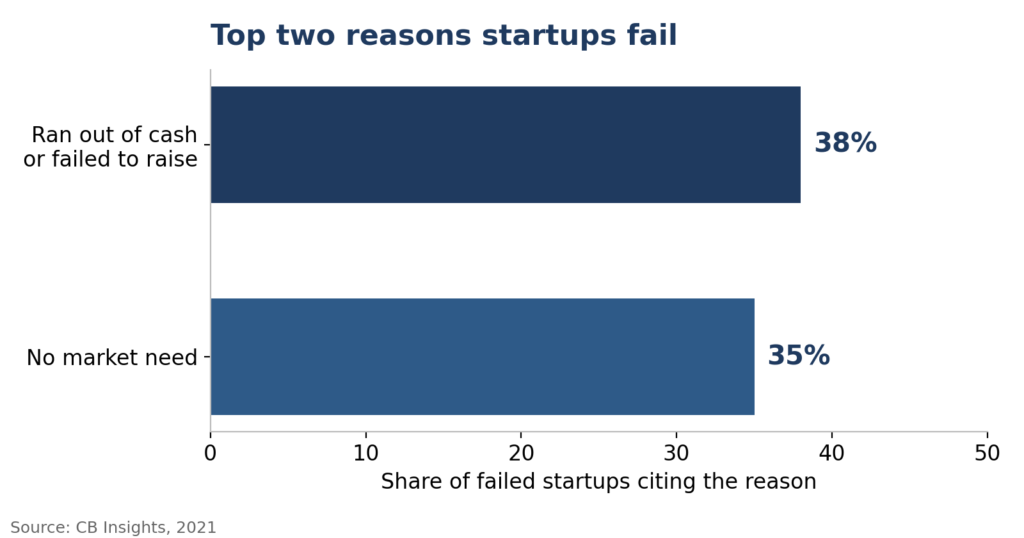
According to CB Insights (2021), 38% of failed startups ran out of cash and 35% found no market need for what they built. Marketplaces risk both, burning cash on one side while waiting for the other.
The other killer is breadth. Founders launch “every home service in the country” when they should launch “dog walkers in two zip codes.” Thin supply spread across a big map feels empty everywhere.
The prize is real, though. Digital Commerce 360 (2024) estimated the top 100 online marketplaces sold over $3.8 trillion in goods in 2023. Buyers love marketplaces. Just not empty ones.

Validating Demand Before You Write a Single Line of Code
Before you spend a dollar on marketplace app development, prove that people will transact. Not sign up. Transact.
My favorite test is embarrassingly simple: a landing page, a Google Form, and a WhatsApp group. Match buyers and sellers by hand for two weeks.
A validation checklist you can start today
- Interview 15 people on each side about what they use now and what it costs them.
- Get at least 10 buyers to pay something, even a small refundable deposit.
- Recruit 20 suppliers willing to fulfill orders manually.
- Track your fill rate. If you can’t fill 60% of requests, your supply problem is real.
If you can’t make matches with spreadsheets and phone calls, an app won’t save you.
Building a Lean Marketplace MVP
Your marketplace MVP needs five things: listings, search, messaging, payments, and reviews. That’s it. Everything else is a distraction dressed up as a feature.
Listings should take under three minutes to create on a phone. Search can start as simple filters for category and location, so skip the AI ranking for now. Messaging keeps deals on platform, payments via Stripe Connect or similar collect your take rate, and reviews let strangers trust strangers.
Skip loyalty programs, fancy dashboards, and multiple languages until volume demands them.
You don’t need to build every pipe yourself, either. Gartner (2021) predicted that 70% of new applications built by organizations would use low code or no code technologies by 2025. Buy the plumbing and spend your budget on matching.
Choosing the Right Tech Approach: Native vs Cross Platform Mobile Applications Development
Here’s my honest take. For roughly nine out of ten marketplaces, Cross Platform Mobile Applications Development is the right call. You’re building feeds, chat, and checkout, and none of that pushes a phone’s hardware.
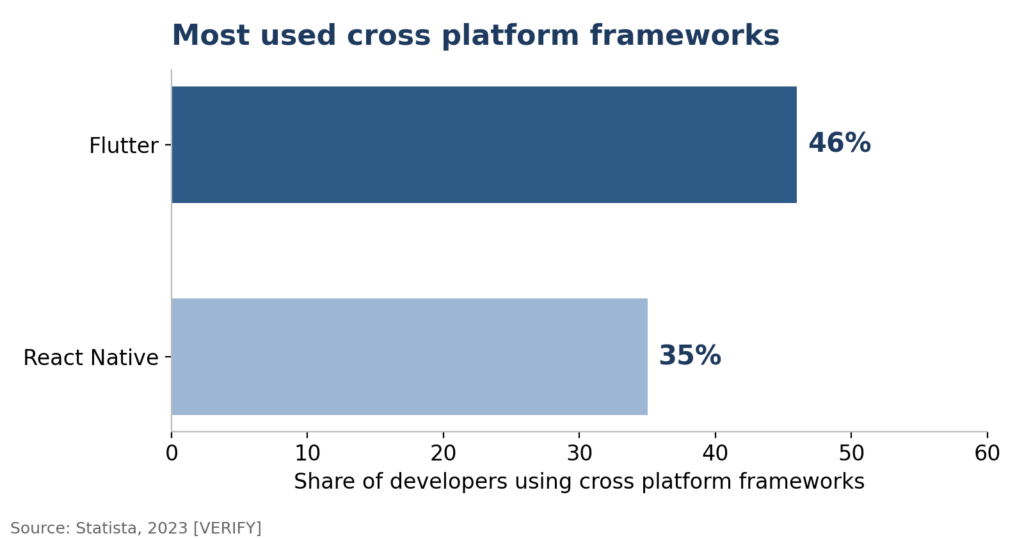
Frameworks like Flutter and React Native let one team ship iOS and Android from a single codebase. Statista (2023) reported that about 46% of developers using cross platform frameworks worked with Flutter, and about 35% with React Native. That talent pool makes hiring easier.
Go native only when your core experience depends on the device itself, like AR, heavy camera work, or constant background location. Otherwise you’re paying twice for polish nobody notices.
How to Pick the Best Mobile App Development Agency for Your Marketplace
This is where plenty of founders lose six months. The right partner isn’t the flashiest portfolio. It’s the team that has shipped a marketplace and can explain split payouts without checking notes.
Questions to ask on the first call
- Which two sided products have you launched, and how did they perform?
- How do you handle escrow, payouts, and refunds?
- Who owns the code, the repository, and the cloud accounts from day one?
- What would you cut from my scope, and why?
Red flags
A fixed quote before any discovery work. No questions about your business model. A yes to every feature. A good Mobile Applications Development Agency pushes back, because extra features delay your first sale.
Pricing models
Fixed price fits a tightly scoped MVP, time and materials suits a product still changing weekly, and a dedicated team makes sense past 100 transactions. In my experience, a lean marketplace MVP in 2026 costs $40,000 to $120,000, depending on region and complexity.
Solving the Chicken and Egg Problem: Which Side to Seed First
Seed supply first, almost always. Buyers who find an empty shelf leave and rarely return. Sellers will tolerate a quiet week if you’re personally sending them leads.
A founder I advised built a local services marketplace for home cleaners. Buyers loved it, but only 11 cleaners had joined, so nearly half of all bookings went unfilled. She paused buyer ads, spent three weeks visiting cleaning crews in person, and guaranteed each new cleaner five paid jobs in month one, covering any shortfall herself.
Her fill rate climbed from 48% to 86%, and her paused buyer ads suddenly paid for themselves.
The exception? When supply is plentiful and demand is scarce, like freelance design, seed buyers. The chicken and egg problem is solved by seeding whichever side is constrained right now.
Getting to Your First 100 Transactions
The first 100 are handmade. Nobody discovers a new marketplace through app store search.
Run it like a concierge. Match early buyers with sellers yourself, write listings for suppliers, and follow up after every job. Airbnb’s founders famously photographed hosts’ apartments themselves. Find your version of that.
Then go narrow. One niche, one city, maybe one neighborhood. Twenty transactions a week in a tight area teach you more than two a week across a country. Every manual step you repeat shows what to automate next.
Scaling from 100 to 1,000 Transactions
Around transaction 100, your personal effort stops scaling. Now the product carries the load, and three levers matter most.
Trust
A camera gear rental app I worked with had plenty of listings, yet renters kept abandoning checkout. Owners feared damage; renters feared fakes. The team added ID checks, an escrowed deposit, and pickup photos. Checkout completion rose from 22% to 51% in six weeks, and they crossed 1,000 rentals four months later.
Retention and referral loops
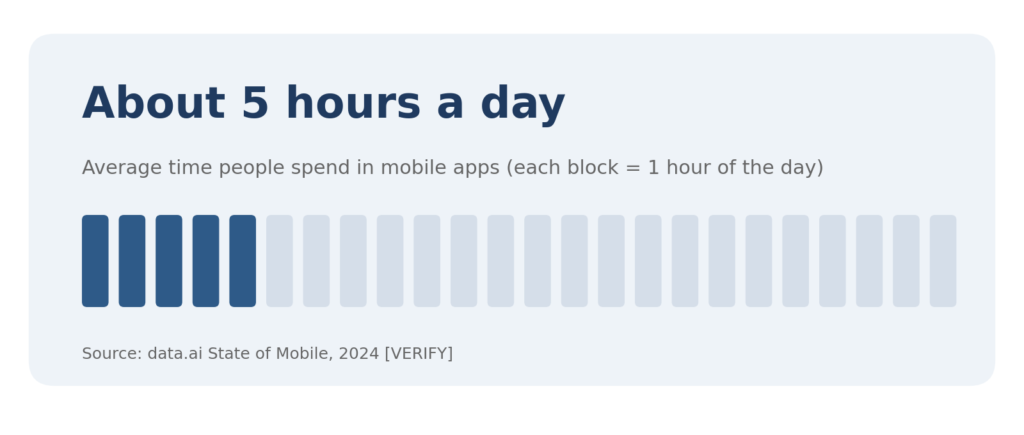
Retention beats acquisition here. Send a rebooking nudge right after a five star review, and reward referrals on both sides: credit for buyers, a fee discount for sellers. data.ai (2024) found that people spend around five hours a day in mobile apps, so a well timed push notification is often your cheapest channel.
Take rate
Most marketplaces I’ve seen charge between 5% and 20%. Start lower than you think, prove value, then raise it. If deals start moving offline, your fee exceeds the value you add. Fix the value first.
Metrics That Actually Matter
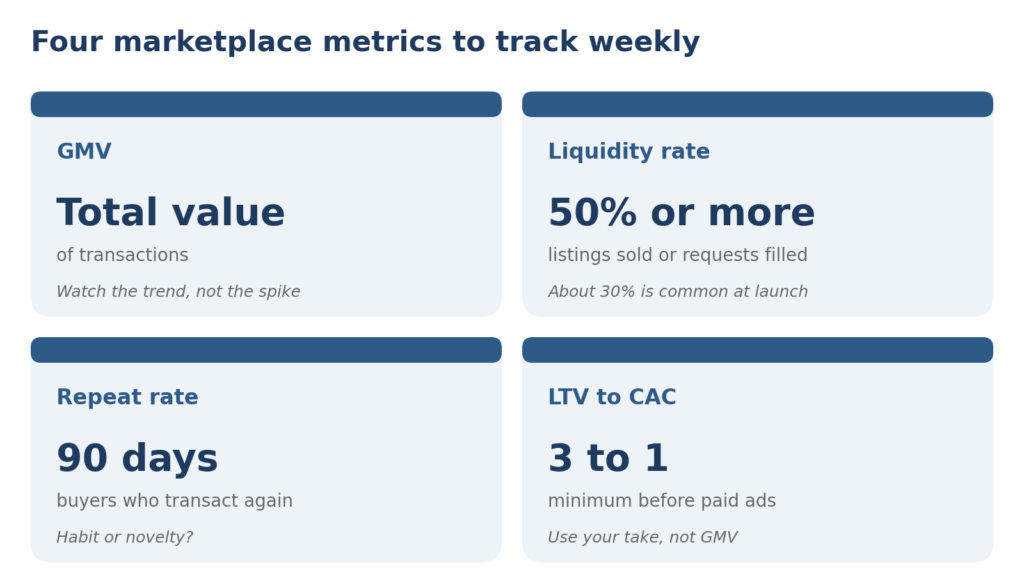
Downloads and signups feel great right up until the money runs out. Track these four weekly instead.
- GMV (gross merchandise value): total transaction value on your platform. Great headline, but it hides churn.
- Liquidity rate: the share of listings that sell, or requests that get filled, within a set window. Around 30% at launch is common, and 50% or more means you’re getting somewhere.
- Repeat purchase rate: the share of buyers who transact again within 90 days. Habit or novelty? This tells you.
- CAC vs LTV: what a buyer costs to acquire versus the revenue they bring you (your take, not GMV). Aim for LTV of at least three times CAC before you pour money into paid ads.
Your Next Step Toward the First 1,000 Transactions
Building a marketplace that actually sells comes down to one boring truth: focus beats features. Validate by hand, launch a lean MVP, seed the constrained side, and grind to 100 transactions before you worry about scale.
If you’re ready to turn a validated idea into a working product, talk to a Mobile Applications Development Agency that has launched marketplaces before and knows Cross Platform Mobile Applications Development inside out. Bring your validation data and your five core features.
Book a discovery call this week. Your first sale is closer than it feels.