




Somewhere around the twenty person mark, most SaaS founders hit the same wall. The product is gaining traction, the roadmap is full, and the two or three engineers who built the first version are now stretched across support tickets, new features, and infrastructure fires. A hiring decision that used to feel optional suddenly feels urgent.
This is the moment when the question “should we build an in house team or bring in a dedicated development team” stops being theoretical. Industry surveys of SaaS operators consistently point to engineering capacity, not sales or marketing, as the most common growth bottleneck at this stage.
There is no universally correct answer here, despite what most comparison articles claim. The right model depends on your budget, your product complexity, your timeline, and how much control you need over daily execution. This article breaks down both models honestly, with real cost and speed data you can actually use, a practical decision framework, and an illustrative case study showing how the tradeoffs play out in practice.
What Is In House Development
In house development means hiring engineers directly onto your payroll, managed internally, working exclusively on your product. They sit inside your company culture, report to your CTO or VP Engineering, and build institutional knowledge over time.
Pros:
- Deep, compounding product knowledge that rarely leaves the building
- Full control over process, tooling, and priorities
- Stronger alignment with company culture and long term vision
- Easier real time collaboration across product, design, and engineering
Cons:
- Slow hiring cycles, often several months per senior engineer
- High fixed costs even during slow quarters
- Limited access to niche or emerging skill sets
- Turnover risk concentrated in a small, hard to replace team
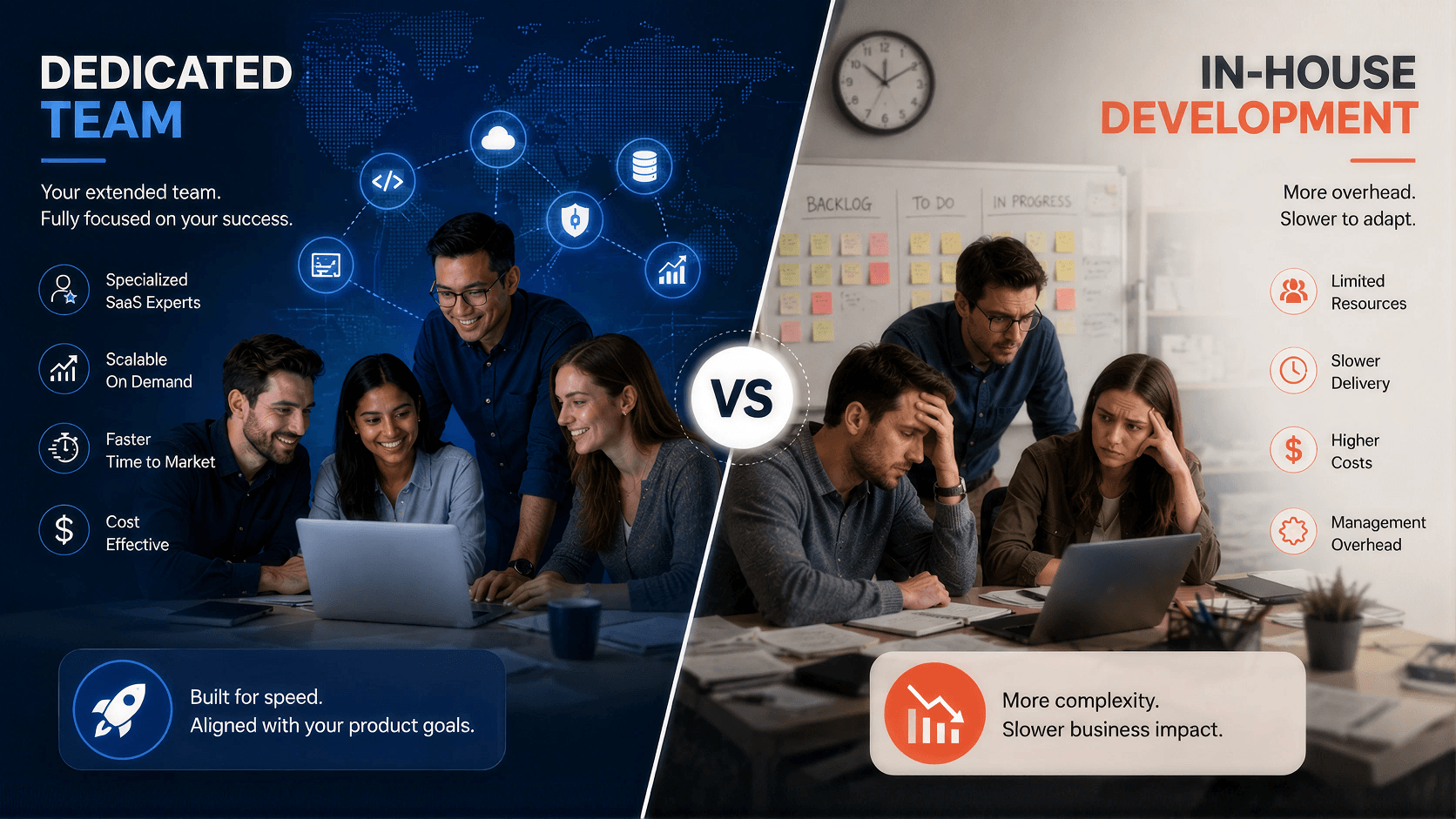
What Is a Dedicated Development Team
A dedicated development team is a group of engineers provided by an external SaaS Development Company who work exclusively on your product, often integrated directly into your existing workflows, tools, and communication channels. Unlike freelancers or short term contractors, this model is built for sustained, ongoing product work.
Pros:
- Faster ramp up since the provider has vetted talent ready to deploy
- Flexible scaling up or down based on roadmap needs
- Access to specialists (security, DevOps, mobile, AI) without full time hires
- Lower administrative burden around benefits, payroll, and compliance
Cons:
- Slightly less day to day cultural integration
- Requires strong communication practices across time zones
- Quality depends heavily on choosing the right partner
- Less direct control over individual hiring decisions
Cost Comparison: In House vs Dedicated Team
Cost Factor
In House Team
Dedicated Team
Often 1 to 3 weeks, since teams are pre assembled
Many SaaS teams report meaningful savings when shifting mid sized product work to a dedicated model, though exact figures vary widely by region, seniority, and project scope, so treat any specific percentage as directional rather than guaranteed.
Speed to Market: How Fast Can You Actually Ship
Time is often more expensive than money for an early or mid stage SaaS company. A feature that ships three months late can mean a lost renewal cycle or a competitor closing the gap.
Average Time to Assemble a Productive Team
Model
Average Time to First Productive Sprint
This table can be recreated as a simple horizontal bar chart in Excel or Canva, with “Weeks to Productivity” on the x axis and each model listed on the y axis. In house hiring consistently shows the longest bar, dedicated teams the shortest reliable bar, and freelance mixes the shortest but least consistent.
The gap above is not just about recruiting speed. A dedicated team from an established SaaS Development Company arrives with existing workflows, code review standards, and QA processes already in place, which removes weeks of process building that new in house teams typically absorb quietly.
Scalability and Flexibility
In house teams scale in discrete, expensive steps. Adding capacity means opening a new req, running a full hiring cycle, and committing to a long term salary obligation, even if the workload later shrinks. Scaling down is worse, since layoffs damage morale and slow remaining work through disruption.
Dedicated teams scale more like a utility. Need two extra backend engineers for a three month push toward a major release? Most providers can add them within days. Need to shrink after launch? Contracts typically allow that without the emotional and legal weight of layoffs.
This flexibility matters most for SaaS companies with:
- Seasonal or campaign driven feature spikes
- Uncertain funding runway
- Rapid pivots based on market feedback
- Multiple parallel initiatives competing for engineering time
Quality and Expertise
The assumption that in house always means higher quality does not hold up well under scrutiny. Quality depends on who you are actually able to hire, not on the employment structure itself.
A well known limitation of small in house teams is narrow skill coverage. A five person team might be strong in backend architecture but thin on mobile, security, or DevOps. Filling every gap internally is expensive and slow.
This is where partnering with a provider offering broad SaaS Application Development Services becomes a real advantage. Instead of hiring five specialists for occasional needs, you get on demand access to a bench of vetted experts across infrastructure, front end frameworks, data engineering, and compliance, brought in exactly when the roadmap calls for them.
The Best SaaS Development Company partners also bring cross client pattern recognition. They have already solved onboarding friction, billing edge cases, and multi tenant architecture problems across dozens of other SaaS products, and that experience shows up in fewer avoidable mistakes.
Real World Case Study: Scaling Past the Bottleneck
Consider an illustrative example based on common patterns seen across mid market SaaS companies. Northbeam Analytics (a composite example, not a specific real company) was a project management SaaS platform with 40,000 users and a six person in house engineering team.
By month eighteen, the roadmap had outpaced the team. Two senior engineers had left within four months, taking critical product knowledge with them. A major integration feature slipped by five months, and customer churn tied to missing features climbed noticeably.
Leadership decided to restructure. Instead of continuing to backfill in house roles, they partnered with a dedicated SaaS Development Company to supplement the core team with four engineers, including a DevOps specialist and a security focused backend engineer neither role the internal team had capacity to hire for.
Within the first month, the dedicated team was integrated into existing sprints. By month three, measurable outcomes included:
- The delayed integration feature shipped in six weeks instead of the previously estimated four months
- Infrastructure costs dropped roughly 18 percent after the DevOps engineer restructured cloud spend
- Engineering velocity, measured in completed story points, increased by an estimated 35 percent
- Time to hire additional capacity dropped from an average of twelve weeks to roughly two weeks
The company kept its core in house team for product strategy and customer facing decisions, while using the dedicated team for execution capacity and specialized skills, a hybrid approach that is increasingly common among growth stage SaaS companies.
How to Decide: A Practical Framework
Use this checklist to evaluate where your company actually stands, rather than relying on general advice.
1. Company stage
- Early stage, pre product market fit: dedicated team often reduces risk and cost
- Growth stage, scaling proven features: hybrid model usually works best
- Mature, stable roadmap: in house core with dedicated support for spikes
2. Budget structure
- Limited runway: dedicated team avoids long term fixed obligations
- Strong, predictable revenue: in house investment can pay off over years
3. Product complexity
- Highly specialized domain (healthcare, fintech compliance): consider a Best SaaS Development Company with proven vertical experience
- Standard SaaS feature set: either model works, weigh cost and speed instead
4. Internal control needs
- Need daily, hands on oversight: lean in house
- Comfortable with structured async collaboration: dedicated team fits well
5. Timeline pressure
- Need to ship within weeks: dedicated team almost always wins
- No urgent deadline: in house hiring is a reasonable option
Why Partnering with the Right SaaS Development Company Matters
Choosing a dedicated model is only half the decision. The other half is choosing the right partner, and this is where outcomes diverge sharply between companies that see this as a strategic relationship versus a cost cutting shortcut.
A genuinely strong SaaS Development Company brings more than headcount. Look for:
- A track record of comparable SaaS products, not just generic web development
- Transparent communication cadences and shared project management tools
- Engineers who ask product questions, not just implementation questions
- Security and compliance practices that match your industry requirements
- Flexible contract terms that let you scale without renegotiating everything
The strongest partnerships function less like outsourcing and more like an extension of your product team, one that happens to sit outside your payroll. Founders who treat this relationship as strategic, rather than purely transactional, consistently report smoother collaboration and better product outcomes over time.
Conclusion
Neither model is universally better. In house development offers control and deep institutional knowledge, but comes with slower hiring, higher fixed costs, and narrower skill coverage. Dedicated teams offer speed, flexibility, and broader specialized expertise, but require a thoughtful choice of partner to work well.
For most growth stage SaaS companies, the real answer is not one or the other, it is knowing which parts of your roadmap need direct internal ownership and which parts benefit from the speed and range that SaaS Application Development Services can provide.
If you are weighing this decision for your own product, the most useful next step is usually a conversation with a few potential partners to compare approach, communication style, and relevant experience before committing either way.
Related News