


Education is no longer confined to classrooms and textbooks. As technology continues to reshape how children learn, parents, schools, and EdTech startups across the United States, United Kingdom, Australia, UAE, and India are searching for smarter ways to engage young learners. Traditional learning tools often struggle to hold a child’s attention or adapt to their individual pace, creating gaps that affect long-term academic confidence and skill development.
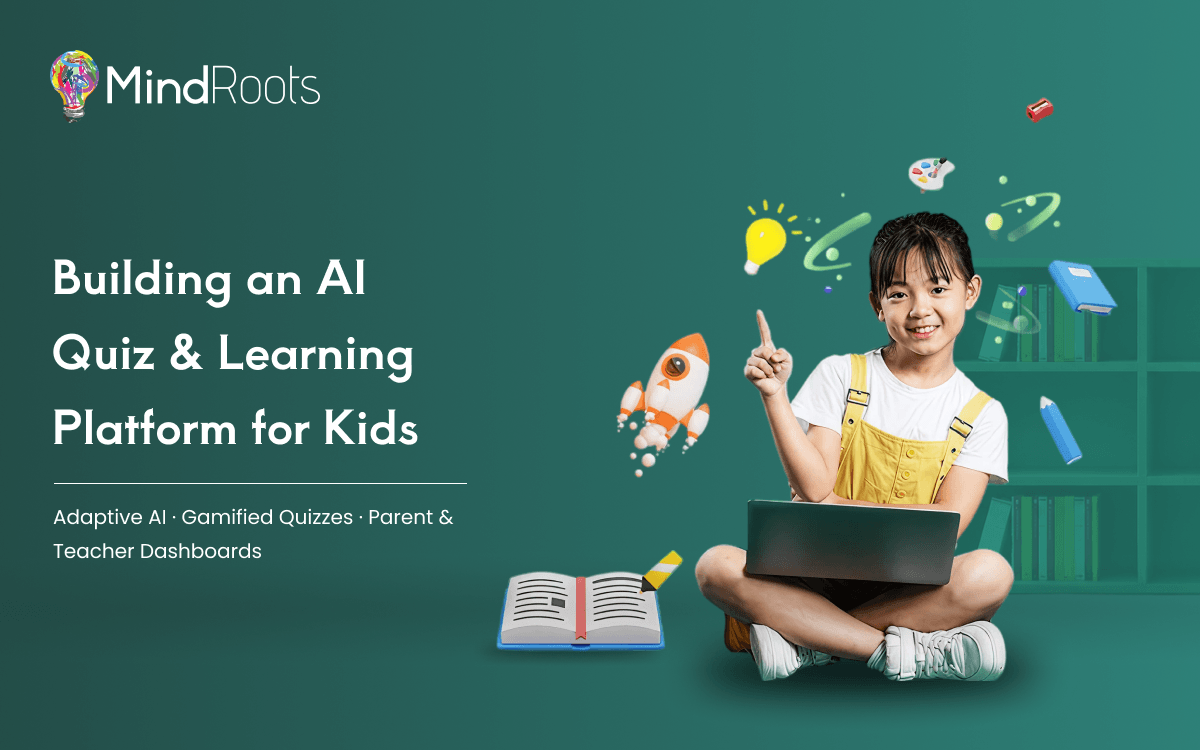
One of our clients approached Mind Roots with a compelling vision: build an AI-powered quiz and learning platform specifically designed for children between the ages of five and fourteen. Their goal was to create a product that could personalise learning pathways, reward curiosity, and make the process of acquiring knowledge genuinely enjoyable for young minds.
This article walks through how we approached the project, the technical decisions we made, the design principles we followed, and the outcomes the platform delivered after launch.
Understanding What Children Actually Need from a Learning Platform
Before writing a single line of code, our team invested time in understanding the real problem. Building for children is fundamentally different from building for adult users. Attention spans are shorter, motivation is driven by fun and reward rather than utility, and the learning experience must feel safe and supportive rather than stressful.
Through discovery workshops with the client, consultations with educators, and research into child psychology and learning behaviour, we identified several core challenges. Children often lose interest when content is too difficult or too easy for their current level. Parents struggle to track progress in a meaningful way. Teachers lack tools that give them visibility into individual learning gaps. And existing quiz platforms tend to be rigid, offering the same experience regardless of whether a child is excelling or falling behind.
These insights shaped every product and technical decision that followed. The platform would need to adapt in real time, communicate progress clearly to parents and teachers, and above all, keep children genuinely engaged through thoughtful design and smart content delivery.
Designing a Platform Architecture Built for Scale and Safety
Given that the platform would serve children, two architectural priorities stood above everything else: performance and safety. A slow or unreliable experience frustrates young users quickly. And because the platform would collect data related to minors, child data protection had to be a foundational requirement, not an afterthought.
We chose React.js and Next.js for the frontend, enabling a fast, responsive interface that works smoothly across tablets, smartphones, and desktop computers. The visual layer was built with Tailwind CSS, allowing us to create a colourful, age-appropriate design system that could be maintained consistently across the product.
For the backend, we used Node.js and Express.js to handle concurrent user sessions efficiently. PostgreSQL served as the primary database, offering the relational structure needed to manage student profiles, learning histories, quiz results, and adaptive content rules. The AI and recommendation components were built using Python-based services, integrated through a microservices architecture. The infrastructure was deployed on AWS with containerised services that scale automatically during peak usage periods. Security was embedded from the start, with encrypted data transmission, strict role-based access controls, and compliance with COPPA, GDPR, and relevant child data protection frameworks across all target markets.
Building the Adaptive Learning Engine
The heart of the platform is its adaptive learning engine, the component that makes the experience genuinely intelligent rather than simply digital. When a child completes a quiz or learning activity, the engine analyses their responses: which questions they answered correctly, how long they spent on each one, where they hesitated, and whether they improved on topics they had previously found difficult. Based on this data, the system continuously updates a learning profile for each student, adjusting the difficulty of future content and surfacing topics that need reinforcement.
We developed the recommendation model using collaborative filtering combined with content-based logic. This means the engine not only responds to an individual child’s own performance but also draws on anonymised patterns from learners with similar profiles to suggest content that is likely to be effective. One deliberate design decision was to avoid making the adaptive logic visible or stressful to children. Content adjustments happen seamlessly in the background, ensuring that every session feels appropriately challenging without ever feeling discouraging.
Creating an Engaging Quiz and Content Experience
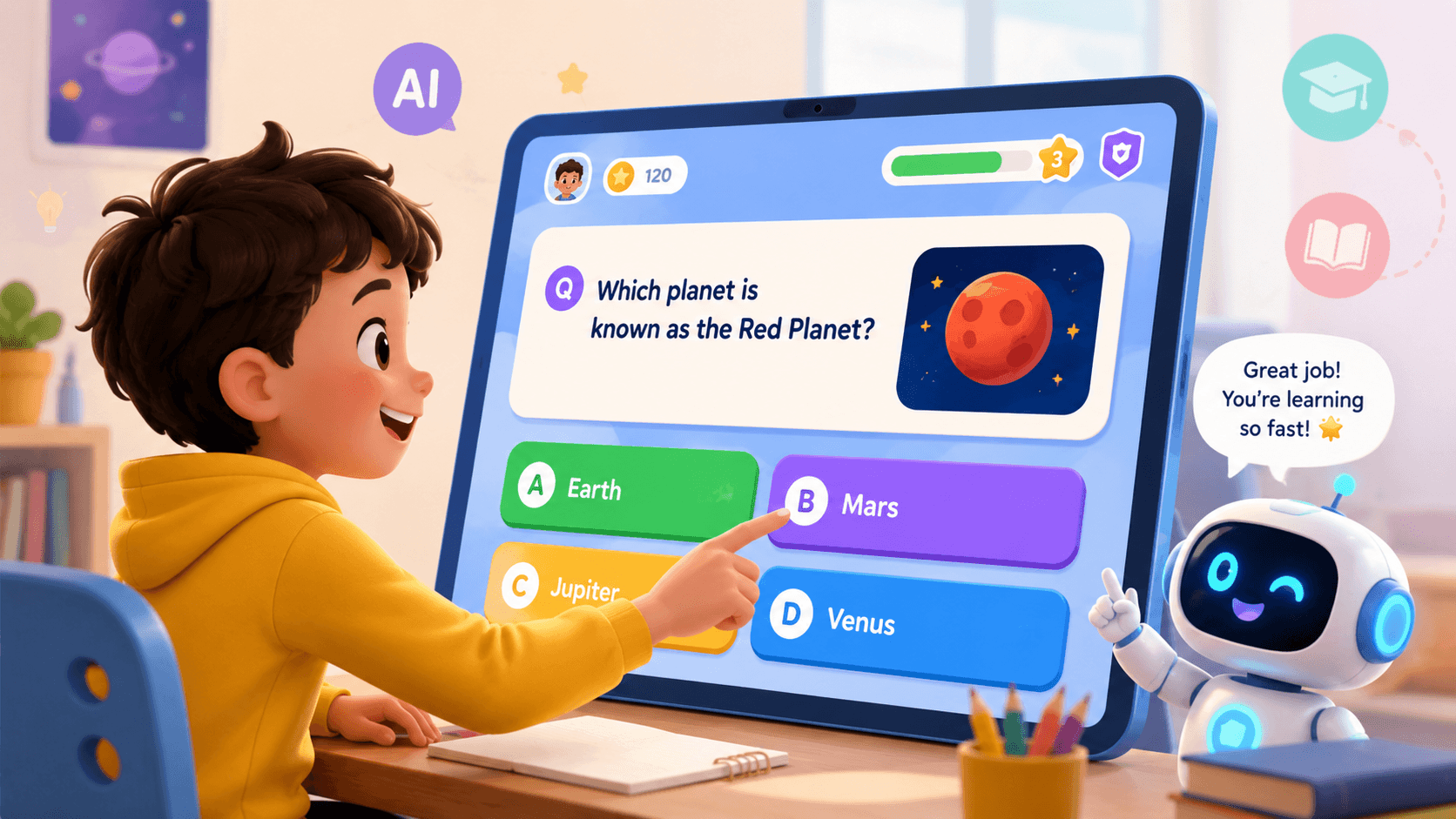
No matter how sophisticated the AI behind a children’s platform may be, it will only succeed if children actually enjoy using it. The quiz system supports multiple question formats including multiple choice, true or false, drag and drop, image-based questions, and short fill-in-the-blank responses. Different formats keep sessions varied and prevent the repetitive feel that causes children to disengage from purely text-based platforms.
We integrated a gamification layer that rewards consistent effort rather than just correct answers. Children earn points, unlock badges, and progress through themed learning journeys. Streak tracking encourages daily engagement without creating anxiety around missing a session. Animated characters guide younger users through each session, offering encouragement and hints without giving answers away. The tone across the platform is consistently warm, patient, and celebratory, reinforcing the idea that making mistakes is a normal and valuable part of learning.
Giving Parents and Teachers Meaningful Visibility
A learning platform for children is only complete when it also serves the adults responsible for their development. We built separate dashboard experiences for parents and teachers, each designed around the specific information they need. Parents can see at a glance how much time their child has spent learning, which subjects they have covered, where they are excelling, and where additional support might be helpful. Weekly progress summaries are delivered automatically by email, making it easy for busy parents to stay informed without needing to log in every day.
Teachers and school administrators have access to class-level reporting that surfaces aggregate performance trends alongside individual student data. This allows educators to identify concepts that multiple students are finding difficult and adjust their classroom instruction accordingly. All progress data is presented clearly and without jargon, making it accessible to parents regardless of their familiarity with educational assessment methods.
Supporting Diverse Markets Across the Globe
The platform was built with international expansion in mind from the beginning. In the United States, content aligns with Common Core standards and supports standardised test preparation. In the United Kingdom, content maps to the national curriculum by key stage. For users in the UAE, the platform supports Arabic language content and right-to-left interface rendering. In India, the platform supports multiple regional languages alongside English and accommodates diverse board curricula followed across different states. Australian schools benefit from content aligned with the Australian Curriculum, while offline mode support ensures that students in areas with limited connectivity can continue learning without interruption.
Addressing Child Safety and Data Privacy
Building a platform for children carries a responsibility that goes beyond standard software development. The platform requires verifiable parental consent before any child account can be created. Children cannot communicate directly with other users through open channels. All AI-generated content and third-party materials are reviewed against child safety guidelines before being made available within the platform. Data minimisation principles were applied throughout the architecture, ensuring that only the information necessary for delivering the learning experience is collected and retained. No advertising is served to child users. The platform operates on a subscription model, which means the business model itself aligns with the best interests of the learner.
Mini Case Study
A fast-growing EdTech startup had built an initial quiz application for school-age children, but despite a promising early user base, session return rates were consistently low. Product analytics showed that most children completed one or two sessions and did not come back. The core issues were quickly identified: the platform delivered identical content to every learner regardless of their ability, there was no reward structure to encourage continued engagement, parents had no visibility into their child’s progress, and the mobile experience was poorly optimised. As the startup prepared to expand from India into the UAE and UK markets, the lack of multilingual support and curriculum alignment made that ambition difficult to pursue.
The company partnered with Mind Roots to rebuild the platform from the ground up. Our team designed and developed an adaptive AI engine that personalises content difficulty in real time based on each child’s performance, a gamification layer built around points, badges, and themed learning quests, and separate dashboards for parents and teachers that surface progress data in plain, actionable language. The platform was built with multilingual support, curriculum mapping for three markets, and full compliance with child data protection regulations including COPPA and GDPR. Within three months of launch, the startup saw a significant increase in daily active usage, substantially higher session return rates, and measurable improvements in learner performance across assessed subjects. Teacher adoption drove early school partnerships, and subscription renewal rates in the first quarter exceeded initial projections, demonstrating that investing in purposeful, child-centred design directly translates into product retention and commercial growth.
Outcomes After Launch
The most meaningful measure of any learning platform is whether it actually improves outcomes for the children using it. Following launch, the client reported strong engagement metrics with daily active usage rates significantly higher than industry benchmarks for comparable EdTech products. Children using the platform showed measurable improvement in subject areas where they had previously underperformed, based on data gathered from pre- and post-assessments conducted through the platform.
Parent satisfaction scores were high, with most users citing progress visibility and the non-stressful tone of the platform as key reasons for continued subscription. Several school partnerships were established within the first few months of launch, accelerating growth in both the consumer and institutional segments. The adaptive engine also began demonstrating increasing accuracy in its content recommendations over time, as the growing dataset allowed the model to make more confident and effective personalisation decisions.
Best Practices for Building an AI-Powered Learning Platform for Kids
Building an exceptional EdTech product requires careful planning and continuous refinement. Follow these best practices:
Start with the Learner, Not the Feature List
Understand how your target age group actually learns before designing any functionality. Child psychology and pedagogy must inform product decisions from the start.
Build Adaptivity into the Core Architecture
Personalisation cannot be added as a layer on top of a static system. The recommendation engine and content delivery logic must be foundational, not supplementary.
Design for Adults as Well as Children
Parents and teachers are co-users of the platform. Their dashboards, notifications, and reporting experiences deserve the same design attention as the child-facing interface.
Treat Safety as a Non-Negotiable Foundation
Child data protection compliance, parental consent flows, and content safety review processes must be built in from day one. Retrofitting safety after launch is both costly and reputationally risky.
Plan for Localisation Before You Scale
International expansion requires genuine curriculum alignment, language support, and cultural adaptation. These are prerequisites for market acceptance, not optional enhancements.
Iterate Based on Real Usage Data
Analytics, session recordings, and structured parent feedback are essential inputs for continuous improvement. The most effective EdTech platforms evolve constantly in response to how children are actually using them.
Conclusion
Building an AI quiz and learning platform for children is one of the most rewarding types of software development a team can undertake, because the impact is both measurable and deeply human. The best technology in this space is invisible to the child using it. They do not think about adaptive algorithms or cloud infrastructure. They simply feel supported, motivated, and excited to keep learning.
By combining thoughtful pedagogy with modern AI, a safety-first architecture, and genuine empathy for how children learn, it is possible to build a product that parents trust, teachers value, and children genuinely enjoy. For organisations looking to enter or grow within the EdTech market, a purpose-built AI learning platform can become far more than a digital study tool. It can become a child’s favourite part of the school day.
Looking to build an EdTech platform your users will love?
Our experienced development team at Mind Roots helps EdTech startups and educational institutions create intelligent, child-centred digital learning products through expert AI development, adaptive platform design, mobile app development, and end-to-end product delivery. Contact our team today to bring your vision to life.
Related News